Showing posts with label Sumrow. Show all posts

Saturday, April 21, 2018

THREE FAMILIES MEET AT THE BATTLE OF RAMSOUR'S MILL

RAMSOUR

Johannes Dietrich Ramsauer came to America in 1727 on the ship “Adventure Galley.” He established himself in Trappe, Philadelphia County, PA for over two decades and had his children baptized at the St. Augustus Reformed Lutheran Church there. 
In the early 1750s, he migrated with a strong contingent of Germans into the Catawba River Valley in central North Carolina. He purchased land, in 1753, in what is now Tryon County (present day Lincoln County), North Carolina. The seasonally stable watercourse, Clark’s Creek, flows through the western side of Dietrich’s land, which made his property ideal for building a water mill. That mill became a source of income for three generations of Ramsour family.

In 1772, having become too old to continue maintaining his farm, he deeded his land and the mill over to his two sons Jacob and David, with the provision that they would build him a cabin and continue to support him until his death. In June of 1780, when he was perhaps eighty years of age, Ramsour’s Mill became the site of a famous Revolutionary War battle. It is likely that the whole family would have watched the battle from a discrete distance, including Dietrich’s daughter Margaret who was about 27 years of age at the time.


SUMMEROUR

Heinrich Summerour came to America when he was twenty nine years of age. He sailed on the ship "Patience" on 16 September, 1748 with his brother Hans and sister Susannah. They settled in Northumberland County, Pennsylvania along with a large population of germanic people who had come to Pennsylvania to find a peaceful place to raise their families. Within a few years of their arrival, they relocated with a couple dozen of their neighbors to what was then Tryon County, North Carolina. The area was nothing but wilderness when these pioneers arrived. They set to work building homes, a church and a schoolhouse, cleared land for farming, and created a community.

Michael Summerour and his brother Henry were the first generation of Sumerours to be born in America. Michael was born 23 August 1756, in what would later become Lincoln County, North Carolina in the family home on Clark’s Creek just downstream from the Ramsauer family property. Michael was twenty years of age when the Revolutionary War began. He proudly signed up for militia duty, to be on call should the war ever approach his home county. Four years later, the battle came nearly to his doorstep. 


BRANDON

John Brandon was born in Lancaster, Pennsylvania in a leap year, and on 29 February 1748. His family had been in America since the 1680s, and he was the third generation born in America. His family moved to Rowan County, North Carolina a few years after his birth. They settled near the Yadkin River, near what would become the quiet town of Salisbury. John's family were well established by the time the Revolutionary War began, and so at 28 years of age, he took a leadership role in the North Carolina militia. He was given a Captain's commission to lead a troop of Cavalry, under the command of his mother’s brother, his uncle Colonel Francis Locke. 

Early in the war, North Carolina had successfully shielded the state from invasion during the Battle of Moores Creek Bridge. For the first four years of the war, North Carolina was fairly quiet. John would have led his men on regular patrols to watch for enemy troops, or Indian activity in the area. The English offered bounty to any Indian who brought the scalp of any rebel combatants. Living as they did so close to the wilderness, Rowan County faced a constant threat from that quarter throughout the war. But the war finally came to the state after General Cornwallis defeated the Americans after a long siege at Charleston, South Carolina. Flushed with his success, he decided to lead his troops into North Carolina. 


THE BATTLE OF RAMSOUR’S MILL

Loyalist John Moore, who had participated in the siege at Charleston, returned to his home in Tryon County and spread the word that the English would soon be marching into North Carolina. Loyalists in the area began to get stirred up, excited about fighting on their home ground. As more and more men were anxious to begin, word was spread that the Loyalists would assemble themselves on the field adjacent to Clark’s Creek, at the site of Ramsour’s Mill. 

On June 13th, they had begun to assemble. With few provisions at hand, they fed themselves on whatever they could steal from local farms. Confrontations were inevitable as their predations became more glaring. Patriots in the area fought back to protect their property, but the Tories outnumbered them. The Patriots sent a messenger to alert their leaders about the Loyalist location.

On June 18th, Patriot General Griffith Rutherford learned that the Loyalists were gathered near Ramsour’s Mill, he began moving his troops and order Colonel Francis Locke to assemble the local militia to assist in the battle. Colonel Locke, along with his nephew Captain John Brandon rode across several counties alerting local leaders to have the militia meet on the road toward Ramsour’s Mill. Among the militiamen who assembled was Michael Summerour, one of Dietrick Ramsour’s neighbors. 

On June 19th, the Loyalist camp had grown to about a thousand and three hundred men. With so many men on their side, the depravations became more severe and more bold. Several armed men patrolled the area and picked up any food that they could lay their hands upon. These raiding parties had picked up several Patriots who had resisted their confiscation of property. The Loyalists made plans to hang the prisoners in the morning. 

Colonel Locke had gathered about four hundred militia men, but General Rutherford had not yet arrived. With the threat that General Cornwallis might soon join the Loyalist gathered near the mill, the Patriots felt that a timely assault might be better than to wait. It was a risky venture, since intelligence had reached them that they would be outnumbered over three to one, but they felt that the alternative would be worse.

The next morning, June 20th, there was a dense fog across the field where the Loyalists had camped. The troops had barely stoked their campfires to prepare breakfast when Patriot forces were spotted on the road just a mile from camp. The Patriot militia men were headed down the road toward Ramsour’s Mill, where they anticipated engaging the enemy, when lookouts first fired upon them. The sound of gunshots alerted the Loyalist camp, and they assembled in ranks to prepare for the onslaught. 

Colonel Locke ordered a cavalry charge against the camp, and Captain Brandon led the way into the fray. After an initial volley of shots, the cavalry retreated and regrouped. Having ascertained the enemy’s position, Colonel Locke ordered a two pronged attack. The majority of his men were to proceed straight down the road to engage the enemy at the front, while he led a smaller group to outflank the enemy.

While Captain Brandon and the larger contingent slowly moved down the road until they were within gunshot, Colonel Locke led his men to the left flank. A simultaneous assault then ensued. The Loyalists quickly understood the threat from the hill to their left. They reformed into a horseshoe to face the enemy fire, with Clark’s Creek covering their left flank. The fighting was brutal, not a single man went unwounded. When a man ran out of ammunition he used the butt of his musket to club the enemy combatants. Brother fought against brother and neighbor against neighbor in bitter, fatal skirmishes.

Colonel Locke ordered his men to fall back so that he could regroup them. However, Patriot Captain John Dickey refused the order to retreat. Though he was a Presbyterian elder and not given to cursing, he soundly cursed Colonel Locke and ordered his men to hold the ridge they were on. Captain John Hardin and his men joined him. Several sharp shooters among them were ordered to aim for those Loyalists who appeared to be well armed with ammunition. The loyalists were soon scattered. 

By the time General Rutherford arrived, the battle was over. The remaining Loyalists were taken as prisoners, and the dead were buried. The Loyalists who participated in the battle had their property confiscated, and the more hostile among them were hanged. The less hostile were paroled and sent home with their word that they would no longer cause any trouble. Those men were good for their word, and Tryon County remained peaceful for the duration of the war.

THREE FAMILY LINES MEET AGAIN

Dietrick Ramsour’s daughter Margaret married Johann Sebastian Klein Jr., and had a daughter named Katherine. Katherine Klein married Michael Summerour, one of the patriot militiamen who fought on his neighbor’s property at Ramsour’s Mill.

Michael Summerour and Katherine Klein had a son John Henry Summerour who married Minerva T. Day. John Henry and Minerva had a son Benjamin Franklin Summerow who married Nancy Elizabeth Brandon. Nancy was the granddaughter of Captain John Brandon, through his son John S. Brandon.

So, Ramsour, Brandon and Summerour families all shed blood together at the battle of Ramsour’s Mill, and were joined once again when their blood intermingled into one family.     


Friday, March 2, 2012

Ida Ophelia Gilley 1880-1953 (101)


Ida Ophelia Gilley was born on 8 Sep 1880 near the township of Hookerville in Burleson County, Texas, to James Andrew Gilley and Almira Elizabeth Decker. Her marriage license confirms her maiden name, and she can be found living with her parents in the 1900 Federal Census, which confirms her connection to her parents.


Ida was a petite woman, with long dark hair and dark eyes to match. Some of her descendants believe that she may have had native American blood, however nothing has been proven along those lines. Her grandparents were pioneers in Texas, so they were well established by the time she was born. Her family owned land in several counties in Texas, but they lived on the farm in Burleson County.


Ida was a talented young lady, who was skilled with words. She won an award for elocution at an early age:
The Caldwell News-Chronicle (Caldwell, Tex.),
Vol. 18, No. 45, Ed. 1 Friday, March 25, 1898,
Page 1 | The Portal to Texas History


With such a gift, it was only fitting that her first job was as a reporter. Between May of 1898 and October of 1900, Ida worked for the local newspaper, the Caldwell News-Chronicle,  as a Rural Correspondent, with the pen name of "Plato." She wrote news about what was happening in her hometown of Hookerville, including who was visiting whom, who was sick and who had gotten well, upcoming nuptials, obituaries, farm news, and pretty much anything else that she deemed newsworthy locally. Here is a sample of one of her articles:

Caldwell News-Chronicle. (Caldwell, Tex.),
 Vol. 20, No. 41, Ed. 1 Friday, March 9, 1900
As a young adult, she also worked as a clerk at her uncle Thomas Gilley's dry goods store in Caldwell, Burleson County, Texas. That is where she and William Sumrow met. She helped him with his purchases, and he took an immediate interest in this bright young woman. 

Thomas F. Gilley's Dry Goods Store, about 1900


They were married on the 3rd of May 1903. Her marriage license gives the following:

"Marriage License. To any Person Authorized by Law to Solemnize Marriage--Greeting. You are hereby commanded to solemnize the Rite and publish the Bans of Matrimony between Mr. William E. Sumrow of Duncan in the Indian Territory, aged 33 years, and Ida Ophelia Gilley of Duncan, in the Indian Territory, aged 22 years, according to law, and do you officially sign and return this License to the parties named.
"Witness my hand and official seal this 1st day of May A. D. 1903. C. M. Campbell, Clerk of the United States Court, signed J. W. Speake, Deputy
"Certificate of Marriage. I D. W. Garvin, Minister of the Gospel, do hereby certify that on the 3rd day of May A. D. 1903, I did duly and according to law, as commanded in the foregoing license, solemnize the Rite and publish the Bans of Matrimony between the parties therein named. Witness my hand, this 9th day of May A. D. 1903, signed D. W. Garwin, Minister of the Gospel
"My Credentials are recorded in the office of the Clerk of the United States Court in the Indian Territory, Southern Judicial Division, Book C, Page 12. Filed and duly recorded this 11th day of May 1903. C. M. Campbell, Clerk of the United States Court"
Ida Gilley and William Sumrow were living in Duncan, Chickasaw Nation, Indian Territory (now Oklahoma) at the time of their marriage. William & Ida claimed that they were married while on board a train. It is unknown which train, or which line they were traveling for this romantic marriage ceremony, or who may have gone with them on their day. We can guess at a few of their special guests.

Ida Ophelia Gilley posing in her wedding dress.

William's brother, James was living in Duncan at the time, and had recently married himself. Ida's aunt Anna (Gilley) Elsey and uncle Thomas Ellis Elsey also lived in Duncan. William & Ida lived either with or near her aunt and uncle for the first couple of years of their married life. They later named a son after Ida's uncle, Thomas Ellis Elsey.

Ida and William had the following children:
1) Merritt Blair Surow b. 13 Apr 1904 in Altus, Jackson, Oklahoma; d. 16 Aug 1965 in Bexar, Texas m. Sophie Lokey
2) James Oran Sumrow  b. 9 Jan 1906 Denton, Denton, TX; d. 13 Nov 1990 Roswell, Chaves, New Mexico m. Adaline Smith
3) Vera May Sumrow 6 Apr 1907 Denton, Denton, TX; d. 1 Apr 1995 in Alvin, Brazoria, TX m. 1st Clyde Russell Owens, 2nd ____ Scarborough
4) Zora Elizabeth Sumrow b. 26 Feb 1910 Denton, Denton, TX; d. 2 Sep 1999 Jacksonville, Duval, FL m. 1st James Lee Owens, 2nd ___ Suggs, 3rd ____ Da Aman
5) Infant Daughter Sumrow b. 16 May 1912 Denton, Denton, TX; d. 16 May 1912 Denton, Denton, TX
6) William Franklin Sumrow b. 5 Sep 1913 Denton, Denton, TX; d. 5 Aug 1975 Chactaw, Oklahoma, Oklahoma m. Crystal Hale Lokey
7) Thomas Ellis Sumrow b. 11 Nov 1917 in Denton, Denton, TX; d. 20 Jun 1972 in Houston, Harris, TX m. Eunice Parker
8) Royce Sumrow b. 28 Sep 1920 Papalote, Bee, Texas; d. 15 Dec 2008 Huntington Beach, Orange, CA m. Allene Hyatt Whitcomb
9) Weldon Sumrow b. 13 Jul 1923 in Winters, Runnels, TX; d. Jun 1946 Hico, Hamilton, TX m. unknown

About 1905, Ida, William and their baby son, Merrit, moved back to Texas. Ida's father may have been ill at the time, or may have died, since we have not been able to pinpoint his date of death. At any rate, it would seem that she went home to be near her mother during this time of grief. It is believed that Ida inherited property from her father. We know, at any rate, that she and her husband had purchased or inherited land spread over several counties during the following decades. William spent the greater part of his life working his own farm, and overseeing the work on his tenant farms as well. Ida worked hard as a farmer's wife, and raised their numerous children. With six strapping boys, and two strong girls, there was plenty of help to keep the farm going.

Ida (Gilley) Sumrow can be found in Denton County, Texas for the 1910 Census.
Ida (Gilley) Sumrow and her family were living in Bee County, Texas for the 1920 Census.
Ida (Gilley) Sumrow and her family were in Willacy County, Texas for the 1930 Census.

Ida and William were Baptists, following in a long tradition in William's family, but about the year 1930, they became interested in some new ideas that were being offered by the Bible Study movement. This group begun by Charles T. Russell and Joseph F. Rutherford, would later evolve into the Jehovah's Witnesses. Ida and William had always been deep thinkers, and this opportunity to study the scriptures in depth had great appeal for them. The questions that they began to ask soon got them in trouble in the Baptist church where they regularly attended, and they were asked by their pastor to please stop coming. They were asking too many difficult questions, and the ensuing discussions were becoming too heated.

This rejection from their pastor pushed them closer to the Bible Study group, and they became ardent followers in the movement. Like the Jehovah's Witnesses, Ida and William soon began to reject the celebration of holidays and anniversaries of every kind. They became resistant to the incursions of modern media, which they saw as worldly temptations, so they refused to listen to radio broadcasts and later to television.

Their strictness in religious observation may have served their needs at the time, but it was repellant to their growing family. William was already a stern disciplinarian at home. Combining his readiness to punish with this expanding view of what were punishable offences, turned him into a tyrant. The result was domestic abuse that took a terrible toll on the children. It created a rift in family ties that had life long repercussions for the children, and grandchildren.

William had promised each of his boys that they would each be given a farm when they reached the age of twenty-one, if they would stay to help on the farm until then. This only added to his armament. Now, he could threaten them with the loss of their inheritance if they didn't stay around to work. As their home became more intolerable, each of the boys had to make the difficult choice about whether to leave or to stay and take the abuse. Only Merritt lasted out the twenty-one years. The rest paid the steep penalty of losing valuable land inheritance by leaving their parents' home early. It was just too uncomfortable at home.

One can only imagine the toll this must have taken on Ida as well. She was much less strict by nature, and by upbringing, than William. As each of her boys made the decision to leave home, it must have been heart-wrenching for her. On the one hand, she probably believed that what her husband was asking of them was right, but she also probably recognized that his cruel manner of enforcing his rules exacerbated the boys' defiance. There was very little she could do as each of her children slipped away.

Ida and her husband were living as boarders in Roosevelt County, New Mexico for the 1940 Census. 
In the 1940s, Ida developed an ugly dark mass of tissue on the end of her nose. The doctor diagnosed this as skin cancer, and recommended that it be removed surgically before it had a chance to spread. In those days anesthesia was not widely used, and was considered dangerous. In order to remove the cancerous tissue the doctor burned it away with a red hot tool. He wanted her to be alert, so that he would know when he had burned down to healthy tissue, some of which he also burned away in case it too may have been contaminated. When the pain would become too severe, the doctor would give Ida a few moments to recover her composure, then begin again. It is difficult to image the kind of agony she must have endured.

After the procedure was completed, Ida had to wait for several weeks for what was left of her nose to heal, and for the swelling to go down. Then she was fitted for an artificial nose, made of metal. She wore this when she went into public, and for most of the later family photographs that she appears in. Over time, she became less self-conscious about her nose, and even had some pictures taken without the prosthetic on.

The Sumrow family about 1950--from left, Oran, Vera, Bill, William, Ida, Merrit, Zora, Tommy and Royce.
Missing is the youngest son Weldon who had passed away in 1946.
In 1949, Ida's husband passed away. He had been taking the air conditioner out of the window to prepare for the cooler fall weather, when he tripped on a hose. The air conditioner fell onto his chest, crushing it. William left all of his property to his eldest son, Merritt, with provision for his wife to have possession of their home until her demise. Though this gave Ida a place to live, she found it terribly lonely. Her solution was to spend a portion of each year with each of her children. This gave her an opportunity to spend time with her grandchildren and to improve the relationships with her sons.

Her strict religion continued with her through the end of her days. One of her granddaughters shared this memory of Ida:

"She was small and slender and stoic. I don't ever remember hearing her laugh. When she came to visit my mother, Zora, in Atlanta, we had the TV on in our home, as they came over to visit my 1st husband and me. My children were babies. Back to the TV: She thought it was a very evil thing and turned her back on it, refusing to look at it. She wasn't mean - just very strict. I remember once visiting them in New Mexico and I said, "Hot Dog", over something. (I was about eight yrs. old.) She gave me a good tongue-lashing, but I didn't know what I said that was so bad. God rest her soul. She was so lonesome and lost after Grandfather died. She would spend 2 months with one offspring and move on to another."

Though she was generally a serious woman, she was also warm-hearted. One of her daughter-in-laws remembered her fondly, and often spoke about how tenderly she treated her grandchildren and how affectionate she was even with the in-laws. Ida enjoyed her visits with her children and their growing families to the fullest.

In time, Ida's body began to weaken. Though she had gone through that extreme procedure with her cancer, it continued to spread to other parts of her body. Eventually, it developed in her brain. This weakened her whole body, and caused a great deal of stress on her heart. Shortly before she died, she had gone to stay with her son, Tommy, in Roswell, Chaves County, New Mexico. On the evening of 20 June 1953, Tommy came home from work, and found that she had laid down for a nap and died. Her death certificate gives the following information:

Place of Death: Roswell, Chaves County, NM
Place of Residence: 506 Pecan St., Hico, Hamilton County, TX
Name: Ida Ophelia Sumrow; female; white; widowed; housewife
Mother and Father's names: Unknown
Death Date: June 20, 1953
Birth Date: Sept. 8, 1879
Birth Place: Caldwell, Texas
Spouse: William E. Sumrow
Informant: Tommy Sumrow
Cause of Death: Acute Coronary Decl.; Chronic Myaconditis


Ida is buried in Hico Cemetery, in Hico, Hamilton County, Texas. She has a double grave marker that she shares with her husband. Her side reads, "Mother Ida O. September 8, 1880 June 20, 1953."


Saturday, February 4, 2012

Minerva T. Day 1806-1868 (10001)

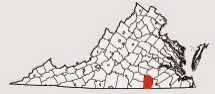
Brunswick County, Virginia
Minerva T. Day was the daughter of Jesse Day and Elizabeth Hearn of Brunswick County Virginia. She was born about 1806 in Brunswick County, and grew up there. She relocated with her family to Rutherford County, Tennessee about 1813. There she met her future husband, John Henry Sumerow, who had recently moved to Rutherford County from Lincoln County, North Carolina.
Rutherford County, Tennessee

They were married in Rutherford County:

Rutherford County, TN Marriage Record for 1820
Summerraw, Henry    &   Day, Minerva        Sept 9, 1820


Minerva and John Henry Sumerow had the following children:
1) James H. Sumerow b. 1822 Rutherford, TN; d. 27 Dec 1852 Lauderdale, TN; m. Sarah E. Wright
2) Mary E. Sumerow b. 13 Jul 1824 Rutherford, TN; d. 8 Jun 1895 Lauderdale, TN; m. James C. Alsobrook
3) Jesse M. Sumerow b. 1826 Rutherford, TN; d. 2 Nov 1875 Lauderdale, TN; m. Sarah Sumerow (his brother's widow)
4) Henry Thomas Sumrow b. 1829 Rutherford, TN; d. 9 Sep 1884 Lauderdale, TN; m. 1st Ellen Smith, 2nd Missouri Jackson
5) George Henry Sumrow b. 28 Jul 1830 Rutherford, TN; d. 4 Mar 1913 Merit, Hunt, TX
6) William C. Sumerow b. 1833 Rutherford, TN; d. Bef. 1870 Lauderdale, TN; m. Matilda Rucker
7) Benjamin Franklin Sumerow b. 1837 Lauderdale, TN; d. Bef 7 May 1879 Lauderdale, TN; m. Nancy Elizabeth Brandon
8) Martha Emma Sumerow b. 1838 Lauderdale, TN; d. Aft. 1870; m. 1st John Rucker, 2nd Benjamin M. Hall; 3rd W. H. Flippin
9) Robert W. Sumerow b. 1848 Lauderdale, TN; d. Abt. 1891 TN; m. Nancy Warren

Shortly after their marriage, the westernmost part of Tennessee opened for settlement. By about 1835, Minerva and her family moved to Lauderdale County, just a few miles east of the Mississippi River. There they were able to obtain a grant of over 1500 acres of land, and there they raised their large family and helped to build the community of Double Bridges.

The Sumerow family settled on land adjacent to the Mississippi River, which is the meandering western border of the state of Tennessee. Their property was at the north-western part of the county, near the border of Dyer County.

The following children were named on the back of Henry's grave marker, as children of Henry and Minerva who had preceded them in death:
1) Eleanor C. Sumerow
2) Robert P. Sumerow
3) Predonia Sumerow
4) Virginia Sumerow
5) Eugenia Sumerow

Considering the ten year gap between Martha b. 1838 and Robert b. 1848, we can imagine that most of these children were born in that interval. They even named another son Robert after the one that they had lost. It is difficult to imagine the kinds of sorrows the family suffered to have lost so many children at a tender age. We can only sympathize with what they must have endured, and the strength it must have taken to continue to carry on in their wilderness home.

They would have had much work to clear the land of cypress, and other trees that dominated the area, before the land could be used for farmland. As they cleared the land, the first priority would have been to grow food crops and farm animals to feed their family. As more land was cleared, they began to grow cotton as a cash crop.

This picture was taken some miles north of the Sumerow family land. This shows the type of cypress forest that dominated the coast of the Mississippi River when the Sumerows arrived in Lauderdale County.   

In 1852, Minerva lost her eldest son, and just two short years later, in 1854, she lost her husband. Her other children rallied around her, and she was able to make it through those tough times. Then the Civil War came. Most of her sons enlisted for service with the confederate army, and worked to protect the Mississippi coast line. However, the Union army soon succeeded in invading the western shores of Tennessee, and ravaged the farmland to support their own troops. It must have been devastating for the entire community to have their stock and the produce that they depended upon to feed their families stolen away from them.

Minerva is living with her daughter Martha Rucker, her son Robert (who is 12), and Martha's daughter Elenora in the 1860 Census, which is after her husband's death. There is also a slave schedule for Minerva which shows her with 13 slaves. This is unfortunate proof that the family had slaves, but also shows that they were well to do at the time. During the war, they must have suffered greatly, since the Union soldiers came into Tennessee from the Mississippi River. Their close proximity to the river would mean that they were among the first to be invaded.

Minerva was not a young woman any more, and the stress of that time took its toll. She survived long enough to see the end of the war, but did not live long enough to see her community rebuilt and recover from their losses. She passed away in 1868. On 3 Feb 1868, her second son, Jesse, applied to be the administrator on her estate, and distributed the landholdings among the surviving children.

I'm uncertain where she is buried. Henry's tombstone was partitioned with two sections. His information is on the right hand side. The left side was obviously set aside for his wife, but that side was blank. She was either buried elsewhere, or they never got around to adding her information to the tombstone. Henry was buried on land that was originally part of their property, and at the foot of his grave is the grave of his daughter Mary Alsobrook and her husband.

----------------------------------------------------------------------------------------
Minerva's Parents:

Jesse Day has been determined to be her father for several reasons.
1) He is the only Day listed in Rutherford County in 1820, where Minerva was living at the time of her marriage.
2) Minerva was born in Virginia. Jesse lived in VA during the 1810 Census, and had a daughter the right age to be Minerva.
3) Jesse moved from Virginia to Rutherford County TN about 1813, when he sold his land in Brunswick County, Virginia. He appears in the 1820 Census in Rutherford County, and still has a female the correct age to be Minerva.
4) Jesse also relocated to Lauderdale County TN at the same time that Minerva moved there with her husband.


Friday, February 3, 2012

Heinrich Summerauer 1722-1792 (1000000)

Heinrich Summerauer's parents have yet to be discovered. We know, from his grave marker, that he was born on 1 Dec 1722. In German, the suffix "er" is added to the end of a surname name in order to indicate that the individual is from a particular place (i.e. a Berliner is from Berlin). So, we know that Heinrich came from a town named Summerau in Germany. One researcher claims that Heinrich came from Bavaria, where they assert that they discovered a small town named Summerau in the Spessert near the river Main. I have found five towns called Summerau in Germany that still exist today, three in Bavaria, one in Rhineland-Pfalz and one in Baden-Wurttenberg. So, it is impossible to know where he came from exactly without further research.

He set sail, with his brother Johannes and sister Susannah, on the ship "Patience" on 16 September 1748 from Rotterdam, to Cowes, England where he signed an agreement of non-hostility to Britain, then on to Pennsylvania. The brothers were listed on passenger ships list as Henrich Somerower, 29, and Hans Somerower, 33. The Captain was John Brown. They also had a sister who came with them, Susannah, though women's names were not included on the ships passenger list. We know of her existence, because she married Hans Ulrich Jakely or Yeakley within months of their arrival, and their marriage is listed in the Pennsylvania Vital Records Index Volume 1: Pennsylvania Marriage Licenses, 1742-1748 (available on Ancestry.com).

It is not known whether Heinrich married before or after arriving in America. No record of his marriage has yet been discovered, and researchers have yet to learn the maiden name of Heinrich's wife Mary. Her first name is derived from her grave marker, which reads "Summerour, Mary 72 years October 25, 1722." We only know that they must have married before 1754, since that is the year their first known child was born.

Heinrich and Mary had the following known children:
1) Michael Summerauer b. 23 Aug 1756 Lincoln (then Anson) NC, d. 11 Jan 1848 Lincoln NC m. Katherine Klein about 1789 Lincoln NC

2) Henry Summerauer b. 1759 Lincoln (then Anson) NC, d. 4 Jun 1836 Lincoln NC m. Elizabeth Weidner about 1784 Lincoln NC

Heinrich Summerauer moved from Lancaster County, Pennsylvania to Lincoln County, North Carolina about 1750.

Heinrich and Mary stayed for a short time in Lancaster County, Pennsylvania, where they mingled with many people from his native land. But soon the opportunity came to settle further west, where land was available at a bargain rate. A group of his neighbors decided to migrate together to form a new community in the western frontier of North Carolina. These people were pioneers in the Catawba River valley in North Carolina. Included in the group were such names as Rhine, Welfong, Yoder, Seitz, Klein, Isenhower, Bolick, Rhinehardt, Mulhl, Linburger, Hilderbrand, Rudisill, Ramasour, Zimmerman, Sherrel, Dellinger, Rinck, and of course Summerow.

Like many new Americans, Heinrich adapted by changing his name to an English friendly version. He became known as Henry Summerow, though he still signed his last name as "Summerour" on official documents in keeping with his German origins. Henry was trusted by his neighbors, and was called to serve on many juries from 1783 through 1790, including some Grand Jury cases.

-------------------------------------------------------

"Henry Summerour" was summoned to serve as juror for January Court 1783 by October Court 1782 in Lincoln County.

"Henry Summerow" was summoned to serve as juror for July Court 1783 by January Court 1783 in Lincoln County.

"Henry Summerow" was sworn in as foreman of the Grand Jury for July Court 1783 in Lincoln County.

"Henry Summerow" was summoned to serve as juror for January Court 1784 by October Court 1783 in Lincoln County.

"Henry Summerow" bought 200 acres of land from Henry Holman; deed dated May 7, 1782; proved by Robert Blackburn at April Court 1784 in Lincoln County.

"Henry Summerow" was summoned to serve as juror for July Court 1785 by April Court 1785 in Lincoln County.

"Henry Summerow" was impaneled and sworn to the Grand Jury and served on the jury for the case State vs Wm Randles; and two cases Wm Graham, Esqr., vs Urbin Ashabranner for January Court 1786 in Lincoln County.

"Henry Summerow" served on the jury for the case Jno Shoeford vs Jno Masters and wife for April Court 1786 in Lincoln County.

"Henry Summerow" sued Phillip Null and won in April Court 1786 in Lincoln County.

"Henry Summerow" was summoned to serve as juror by the April Court 1786 and served for twelve cases in a three day period for July Court 1786 in Lincoln County.

"Henry Summero" served as juror for six cases for October Court 1786 in Lincoln County.

"Henry Summero" served as juror for two cases for July Court 1787 in Lincoln County.

"Henry Summero" was summoned to serve as juror by the April Court 1788 for July Court 1788 in Lincoln County.

"Henry Summero" was impaneled and sworn to the Grand Jury and served on the jury for July Court 1788 in Lincoln County.

"Henry Summero" served as juror for three cases for October Court 1788 in Lincoln County.
Clark's Creek is the thick blue line on the left. Lockhart's
(now Larkard) Creek runs into it horizontally from right
to left. It crosses Summerow Rd, which is confirmation that
the family lived in this vicinity.

------------------------------------------------------------

In the early 1750s through 1780s Heinrich acquired property on Clarke's and Lockhardts Creeks in what would become Lincoln County, NC. Heinrich and Mary lived in the Lincoln County NC area for the remainder of their lives. The following deed records show us where he lived, and how much land he claimed for his family:

------------------------------------------------------------

Lincoln County NC Deeds

Page 108, discontinued. Henry Semerour claims 300 ac in Lincoln Co on Buttermilk Br of Clarks Cr; border: Warlick Dun's old tract, William & John Wilson, & Prop; entered 29 Jul 1784; f30.

The red dot shows where Heinrich lived. This shows his
vicinity to Lincolnton, and as far as Charlotte NC.
p. 109, granted. Henry Semerour claims 168 ac in Lincoln Co on head of Lockharts Cr; border: John Boid; entered 29 Jul 1784; f10.8.

p. 115. granted. Henry Semerour claims 50 ac in Lincoln Co on both sides of Clarks Cr; border: Jacob Cresmore and his own land; entered 26 Aug 1784; f5.

p. 280 granted. John Boyd claims 117 ac in Lincoln Co on head waters of Lockharts Cr; border: Henry Sumrow; entered 24 jan 1786; f11.14.

p. 410 granted. John McGaughey claims 200 ac in Lincoln Co on head waters Lockharts Cr; border: James Lockhart; entered 14 Nov 1786; f20; transferred to Henry Sumrow.

p. 94 granted. Henry Grose claims 100 ac on head of Little Cr waters of Clarks Cr; border: Henry Sumrow and Blackburn; entered 7 Oct 1789.

----------------------------------------------------------------
Here is a sampling from the above claims:


In 1787, Henry sold 263 acres on Clarke's and Lockhardts Creeks to his eldest son Michael , and in 1790 he sold 200 acres on the headwaters of Lockhart’s Creek to his second son, Henry Jr.. Since this constituted the bulk of his land purchases, he must have realized that he was getting too old to work the land any longer and was handing over the reins to his sons.

 ----------------------------------------------------------------

1) "Henry Summero" sold 263 acres to his son "Michael Summero"; deed dated January 14, 1787; acknowledged at January Court 1788 in Lincoln County. This was Henry's land on Clarke's and Lockhardts Creeks, B.-3/291.

2) Henry deeded to his son Henry and Henry's wife Betsy, January 20, 1790, 200 acres of land in Lincoln County on the headwaters of Lockhart’s Creek joining James Lockhart and Robert Blackburn, Lincoln County State Grant # 417, recorded in Book State Grants No. 2, pages 112-113.

-----------------------------------------------------------------

He was listed as Henry Sumrow, Sr., in the 1790 NC Census in Lincoln County with 1 male over 16 and one female, this would be Henry and Mary. His neighbors, on the same page of the census, include Henry Jr. and Michael.


Henry died in 1792, and is buried in Old White Church Cemetery next to his wife, Mary. He is listed on a survey of the Old White Church Cemetery. The tombstone gives his birthdate and says he died at 70 years of age. From this we can estimate his death year as 1792.

----------------------------------------------------------------

Summerour, Henry No Dates
Summerour, Elizabeth 63 years October 21, 1827
Summerour, Michael No Dates
Summerour, Catherine 51 years June 10, 1820
Summerour, Henry 70 years December 1, 1722
Summerour, Mary 72 years October 25, 1722
[Old White Church Cemetery - Lincoln County, NC - Cemeteries Submitted to the USGenWeb Project by W.D. Floyd (wdfloyd@rfci.net) Copyright, 1997 W.D. Floyd]
-----------------------------------------------------------------


Monday, January 16, 2012

Michael Summerow 1756-1848 (100000)

Michael was born 23 Aug 1756, in York County PA, where his parents had recently immigrated from Germany. We believe that Michael was the eldest son of Heinrich "Henry" and Mary Summerauer. He is connected to his parents by proximity, since Heinrich is the only Summerour old enough to be his father living in the county. There is a deed in which Henry Summerour sells Michael the greater portion of his remaining estate before retiring. This deed does not explicitly spell out a familial relationship; however, it does confirm a connection between the two men that implies a familial relationship.

--------------------------------------------------------
Deed between Henry Summerour and Michael:

This Indenture Made this fourteenth day of January and in the year of Our Lord one thousand seven hundred & eighty seven. Between Henry Sumrow living in the county of Lincoln & state of North Carolina of this one part & Michael Sumrow living in the said county of state aforesaid of the other part. Witnesseth that for and in consideration of the sum of ten pounds current money of the state of North Carolina in hand by the said Michael Sumrow unto the said Henry Sumrow before consenting & delivery of this thy present receipt and payment is hereby fully acknowledged hath bargained & sold aliened, enscossed [ensconced], conveyed & confirmed of by these presents doth grant, bargain doth alien enscossency [ensconcency?] And confirm unto the aforesaid Michael Sumrow his heirs & assigns forever a part of two tracts or parcels of land lying and being in the county of Lincoln & state aforesaid, and bounded as followeth, to wit, Beginning at a stone, Jacob Carpenters corner on the waters of Clarke Creek arriving thence west 90 poles to a post oak then No. [North] 150 poles to a black oak sapling, then West  88 poles to a line of the old tract, then crossing the sd line the same course 120 poles to a post oak sapling on Anoveri Heady line, then running with said line, Et. [East] 78 poles to a red oak, then running with another of Hedicks line So. 9 Et. [East] 58 poles to three small white oak saplings, then So. 80 Et. 100 poles to a white oak, thence No. [North] 22 E [East] 180 poles to the Beginning, containing by estimation Two Hundred & sixty three acres be the same more or less as may more fully appear by his majesties patent granted to Peter Summy bearing date the 29th day of April and in the year 1763, and the other bearing date the 28th day of April and in ye year 1768, then conveyed from the said Peter Summy to Henry Sumrow as may appear by the records with all the appurtenances whatsoever situate lying and being as aforesaid with their rights members & appurtenances as whatsoever and the revision & revisions hereditaments , promises hereby granted or intended to be granted & every part and parcel thereof and all rents, issues,  increases & profits to them or any of them residing, belonging or appertaining [unto the land?] and convey the estate and estates, rights, titles, claims and demands whatsoever of him the said Henry Sumrow of or unto the said lands, tenements, hereditaments, & premises hereby granted or intended to be granted with all this appertaining to the sd. Michael Sumrow his heirs and assigns and to the only proper use and behoof of him the said Michael Sumrow his heirs and assigns forever and to hereby to hold the said lands, tenements, hereditaments & premises with all their appurtenances to the said Michael Sumrow his heirs and assigns, and the said Henry Sumrow for himself his heirs exc [executors] doth hereby promise, covenant and agree that he the same Henry Sumrow for himself his heirs exor. [executors] Adminr. [administrators] doth hereby promise, covenant and agree that he shall and will at all times warrant & forever defend the said promises to the said Michael Sumrow his heirs and assigns against all lawful claims & demands whatsoever whereby the above mentioned promises might be affected or encumbered contrary to the true intent and meaning of these presents. In Witness whereof the said Henry Sumrow has hereunto set his hand & seal the day and year first above written.

Singed, Sealed & Delivered      Henry Summerour {Seal}
In the presence of
Robt Blackburn     }       Lincoln County Jany. Sessions 1788
Wm Maclean         }                                                  The within
John McGaughey  }      deed was acknowledged in open court and ordered to be registered            
Witness  Jo Dickson C. C. [County Clerk]

[Lincoln County [NC] land entries, 1783-1795,1798-1853; Land entries 1783-1795 FHL US/CAN Film 19241 Item 1;  Lincoln County NC, Deed Book 3, p. 291]

Deed from Henry Summerour to Michael Summerour (page 1)
Deed from Henry Summerour to Michael Summerour (Page 2)


Michael's family migrated to North Carolina when he was still a child, to what was then Tryon County, now Lincoln County. His family settled in the Catawba River Valley, where the land was selling at bargain prices. They settled in the midst of many German immigrants. It must have been a great comfort to them to have others who spoke their language, and worshipped after their manner, as neighbors. They moved into what was wilderness, and had to build civilization from scratch.

Michael and his brother must have been a great help to their parents, and their hardships made them a close-knit family. Michael lived near his parents until their deaths, and stayed on the land that they had developed, and near the church where they were buried, for the rest of his life.

The earliest record I have found for Michael lists him as a signer of a petition to have a portion of Burke County annexed to Lincoln County, signed 25 Dec 1778. He was 22 years old.

It is highly likely that Michael served as a soldier during the Revolutionary War. Several pieces of evidence point in this direction. The first evidence is that he lived as a neighbor to Derick Ramsour, upon whose property a major battle was fought. It does not seem likely that he would have sat at home while a major battle was waging next door.

The second and third pieces of evidence are Michael's own words. In a pension record for Caspar Bolick, Michael testifies that he served in the Revolutionary War with Caspar, under General Rutherford and Colonel McDonell for an unstated period through December of 1781. Michael also published a letter on July 4, 1844 in the Weekly Standard, as a character witness for one of his neighbors who had been accused of being a Tory. Michael wrote:
"I have this day been shown a publication in the Carolina Watchman, where it is stated that the late Michael Quickel is charged as a Troy in the Revolutionary war; was at the battle of Ramsour's Mills, and was then taken prisoner and put in what they called the "bull pen." In justice to the memory of the deceased I feel it my duty to state what I know of the deceased and his father. The father of the said Michael Quickel deceased, whose name was  Michael Quickel, was a citizen of the county of York, Pennsylvania, and was a Captain of a company in the service of the United States against the British and under the command of Col. Swope, and stationed at newark, in the Sate of new Jersey. As to his son Michael Quickel, deceased, I was not acquainted with him until I removed to this country of Tryon, now Lincoln, where I located about five miles from said Quickel, and was acquainted with him until his death; and with regard to the trying times of the Revolutionary war, and particularly the part taken by the said Quickel at Ramsour's Mills, I can say with pleasure that I never heard that the said Quickel took any part with the Tories in that battle, nor in any other. But I saw him on the following day on the battle ground while the whigs had uninterrupted possession of the field, assisting in burying the dead, all the tories who were taken prisoners being under guard.
Michael (his mark) X Summerow, Witness M. Reinhardt


No corroborative evidence has yet been found of Michael's service, but since Michael never applied for a pension himself, it would seem that he had nothing to gain by lying for his neighbors. So, it is likely that he served.

In the late 1780s, Michael began to collect land of his own to develop. On 4 Jan 1786 Michael bought 100 acres of land on the waters of Clark's Creek, joining Jacob Carpenter, John Sigman & Peter Lear [Lair]. On 6 May 1786 Michael bought another 100 acres of land joining David Ramsour's old tract, and next to Henry Grifemore [or Crismore] and James Wilson. A year later, he initiated purchase on an adjoining tract of 86 acres, but the grant was discontinued.

----------------------------------------------------------
Lincoln County NC Deed Records

p. 263 granted. Michael Sumrow claims 100 ac in Lincoln Co on waters of Clarks Cr; border: Jacob Carpenter, John Sigyean, & Peter Lear; entered 4 Jan 1786; L10.

p. 329 granted. Michael Sumrow claims 100 ac in Lincoln Co; border: David Ramsour's old tract, Henry Grissmore, & James Wilson; entered 6 May 1786; L10.

p. 485 discontinued. Michael Sumrow claims 86 ac in Lincoln Co; border: David Ramsour desc, Henry Crismore, & his own land; entered 14 Apr 1787; L8.12.
----------------------------------------------------------


Clarks Creek, where Michael Summerow lived, marks the western border of the town of Lincolnton in Lincoln County NC. Here is a map to show its location. Michael's land was actually further downstream, north of Lincolnton. 
The red pin is at the mouth of Clarks Creek, which flows down from the north-east of Lincolnton.

And this map shows where Lincolnton is located in North Carolina:
Lincolnton is in the south western region of North Carolina, just to the right of the red pin.

One of the neighboring families who had relocated to the Catawba River Valley with the Summerows were the Kleins. Michael fell in love with their daughter Katherine Klein, and they were married in Lincoln County, NC. A marriage record has yet to be found, but we know that they must have married before the Federal Census was taken in 1790, because they appear in that census in Lincoln County NC as a couple without any children.


Michael and Katherine had the following children:
1) John Summerow b. 1791 Lincoln, NC, d. 1857 Iredell, NC; m. Nancy MNU
2) John Henry Summerow b. 1794 Lincoln, NC, d. 5 Nov 1854 Lauderdale, TN; m. Minerva T. Day 9 Sep 1820 Rutherford, TN
3) Michael Summerow b. abt 1795 Lincoln, NC, d. 5 May 1870 Travis, TX; m. Electra MNU MO
4)Jacob Summerow b. 15 Jul 1797 Lincoln, NC, d. 2 Nov 1889 Mitchell, NC; m. Rachel Zelpha Turner 25 Sep 1830 Tyron, Polk, NC
5) Andrew Summerow b. 1800 Lincoln, NC, d. 1831 Iredell, NC; m. Charlotte MNU bef 1822
6) Elizabeth Summerow b. 3 Aug 1801 Lincoln, NC, d. 13 Jul 1861 Lincoln, NC; never married
7) David Summerow b. 16 Sep 1804 Lincoln, NC, d. 23 Jun 1879 Lincoln, NC; m. Susan Rudisill 7 Jun 1828 NC
8) Peter Summerow b. 11 Dec 1808 Lincoln, NC, d. 2 Nov 1841 Lincoln, NC; m. Elmyra R. Ramsauer 16 Mar 1840 Lincoln, NC
9) Sarah "Sally" Summerow b. 12 Jan 1814 Lincoln, NC, d. 22 Oct 1841 Lincoln, NC; never married

Michael's name has been recorded many ways, as is evident census records in which he appears.

1790 Census Lincoln County, NC
"Mich'l Sumrow" 1 male over 16, 0 males under 16, 1 female over 16

No Sumrow/Summerow/Summerour family have been found in the 1800 Census, in spite of searching the census page by page for all of Lincoln County. It must have been an enumerator oversight.

1810 Census Lincoln County, NC
"Mich'l Sumro" 2 m under 10 (b. 1800-1810), 3 m 10-15 (b. 1795-1800), 2 m 16-25 (b. 1785-1794), 1 m 45 and over, 1 f 10-15 (b. 1795-1800), 1 f 45 and over

1820 Census Lincoln County, NC
"Michael Sumrow"
2 m 10-16 (b. 1804-1810) David, Peter
1 m 16-26 (b. 1794-1804) Jacob [Andrew may already be deceased at this time]
1 m over 45 (b. bef. 1775)Michael Sr.
1 f 10-16 (b. 1804-1810) Sally
1 f 16-26 (b. 1794-1804) Elizabeth
[Katherine is deceased]

1830 Census Lincoln County, NC
"Michael Summerow"
1 m 20-30 (b. 1800-1810)
1 m 70-80 (b. 1750-1760)
1 f 15-20 (b. 1810-1815)
1 f 20-30 (b. 1800-1810)


In the 1840 Census, he is living with his son "Peter Summerow" in Upper Regiment, Lincoln, NC. Listed as one male 80-90 years old.


Testimony of Michael Summerow for Caspar Bolick's
Revolutionary War Pension Application

Two of their children, Michael Summerrow Jr. and John Henry Sumerow, followed in their grandparents footsteps, migrating to the ends of civilization to continue pioneering the west. Most of the children stayed near their parents. Katherine died in 1820, leaving Michael a widower for nearly thirty years  before he joined her. When he grew feeble, toward the end of his life, his son Peter moved in with him and took over the labor on the farm.

The following is a faithful transcription of the Will of Michael Summerour Sr. from 1831, as well as the codicil of 1835.

------------------------------------------------------------
In the name of God, amen.
I, Michael Summerour Sr., of the county of Lincoln, and the State of North Carolina, knowing that it is appointed for all men once to die. Being weak, and frail in body, but of a sound and disposing mind, and memory, and wishing to dispose of the property which it has pleased God to bless me with in this world.

In the first place, I give and bequeath to my daughter Elizabeth Summerour $25 in cash, all the cattle she owns, and a good cow out of my stock, two good beds, and furniture, my house clock, my loom and tackle, a bureau which she claims, her side saddle, a large wash kettle, a cook pot, dutch oven, frying pan and skillet, half my dresser] furniture, and a spinning wheel and cards.

To my daughter Sally Summerour, I give $25 in cash, a good cow and a heifer, a good bed and furniture, a spinning wheel and cards, a cook pot, a dutch oven, frying pan and skillet, and half the dresser furniture.

To my son, Peter Summerour, I give $25 in cash, in place of a colt, which I gave the other boys that did not learn trades.

To my son, Jacob Summerour, I also give $25 in money, because I gave him no colt.

To my grandson, Franklin Summerour, son of Andrew Summerour, deceased, I give $100 in cash, which is to be placed in the hands of my son John Summerour, by my executor who is to hold this saying as a guardian for my said grandson, and should it be necessary, he is to appropriate so much thereof as will be sufficient to give him a good common English education, and the balance (if there should be any left) to be paid over to him when he arrives at the age of 21 years, but should he die before he arrives at the age the money is to be refunded to my estate and equally divided among my children. My said grandson, is to have no more of my estate, because I have paid a debt of $161 for my son Andrew since his decease, which he had contracted in his lifetime, for which I was his security.

I give my son Henry Summerour, (who lives in Tennessee) a power of attorney to sell a tract of land, about 276 acres, which lies in Sumner county Tennessee. He was to have half the proceeds of the sale, as his legacy, but I understand that he has made a very bad sale of it. He is to keep the whole of the proceeds of said sale of land as his share of my estate, and he is to have [the word "no" is probably missing] more out of my estate.

My son, Michael Summerour, left a note with me for some better than $12 which I collected, my executors are to pay him $14 in place thereof (if I do not pay him before I die).

I have given my son, David Summerour, a deed of conveyance for [blank] acres of land, a part of the tract whereon I now live, he agreed to allow me at the rate of five dollars per acre. He has advanced me one hundred dollars in cash. I was owing him some small debts, and after settlements he still owes me about twenty-five dollars which he agreed to pay me. The balance of the price of said tract of land which is at the rate of three dollars & fifty cents per acre. He is to account for at the division of my Estate among it and my children & should each ones share of the general divide not amount to that much, he must pay up: such a part as will make his hsare equal with the others. Should there be more than that amount coming to each one, he is to have an equitable share.

The balance of my property not heretofore disposed of, or bequeathed, is to be sold at publick sale (both real & personal) on a reasonable credit, and after all my first debts; funeral expences &c are paid: The balance then remaining of my estate is to be equally divided among my children. John Summerour, Michael Summerour, Jacob Summerour, David Summerour, Peter Summerour, Elizabeth Summerour & Sally Summerour.

I hereby nominate and appoint my son David Summerour & my friend John Coulter as my Executors to execute this my last will & testament.

I do hereby revoke, disannul & disallow all other or former wills by me made & constitute & ordain this to be my last will & testament. Executed, signed & sealed this 16th day of July 1831, in the presence of
David Carpenter
Jacob Summerow  Jurat

Michael Summerour [Could be Summerow, it is difficult to read, because obscured by Seal ring.]

I, Michael Summerour Sr. who executed the foregoing will, having made some alteration in my property, since the execution of the same think proper to make some alteration in the same, by annexing this codicil. To my daughter Elizabeth and my daughter Sally, I have given the cattle that they were to have. To my son Peter, I have willed $25 in cash. I have since given him my part of a threshing machine (which was built in Co. Jonas Hediah [?] D. Carpenter and others), he is therefore not to have the aforesaid $25.

The whole of my estate, after the special bequests are made, is to be equally divided between my sons, John, Jacob, David and Michael, and my two daughters, Elizabeth and Sally. My son Peter, is not to have any of my estate, except such as particularly devised to him. I do hereby constitute this codicil as a part of the foregoing will and wish is to be considered as a part thereof, in witness whereof I Michael Summerour Sr. have hereunto set my hands and affixed my seal the 14th day of December 1835, in presence of John Hedick, Jurat and Catherine Coulter.
           his
Michael Summerour
          mark

[Note: The Will is filed under the name Michael Summerow, though he signed it Summerour]
--------------------------------------------------------------------------

Michael Summerour Will Page 1
Michael Summerour's Will Page 2
Michael Summerour's Will Page 3
Codicil to Michael Summerour's Will

Michael's tombstone has worn over the years, so that the dates can no longer be read. Most researchers had given Michael's Will Codicil date as his date of death (1835). However, an estate sale record shows that his estate was not probated until 1848.


-----------------------------------------------------------------------
The Return of the Sale of Property of Michael Summerow, Dec’d, David Summerow [son], Executor; list of buyers: Elmira Summerow [widow of Peter Summerow, Michael’s son], Solomon Finger [son of Susannah, his niece], David Summerow [son], John Summerow [son], John Coulter, B. F. Summerow [Benjamin Franklin Summerow, son of Michael's deceased son Andrew], Elizabeth Summerow [daughter], Jacob Killian, and Jacob Summerow [son].
[Lincoln County, North Carolina, probate records, 1831-1964; Inventories and accounts of estates 1831-1868 FHL US/CAN Film 422257]
-----------------------------------------------------------------------


There are four pieces of evidence to show that this estate sale was for Michael Sr. and not for his son (as had been falsely reported by early researchers). The first discovery was learning of the location of Michael Jr. at the time of his father's death. Michael Jr. was still alive as late as 1880, and was living in Arkansas in the 1840s. The second piece of evidence was the1840 US Federal Census, that shows that Michael Sr. was living with his son Peter Summerow. The third piece of evidence is the most decisive of all. It is a note in the estate settlement records of 1848, which indicate that Michael had extended credit to Daniel Ramasour on 12 January 1848. So, he was still alive as of that date.


The final discovery was of Michael Summerow's obituary, published in the Lincoln Courier on January 20th, 1848. It reads as follows:
"Obituary.
Another Revolutionary gone! --Died, in Lincoln county, on the 11th instant, Michael Summerour, aged 91 years, 4 months and 19 days. he was born and raised in the State of Pennsylvania, but migrated to this State about the commencement of the Revolutionary war, in which he took an active part on the side of liberty. He has always been a Patriot, and a consistent friend of the rights of man. Peace to his ashes!"


Michael was buried near his parents in Old White Church Cemetery, beside the church that he had helped build and had attended throughout most of his life. His name can still be read on the grave marker.

-------------------------------------------------------------
Survey for Old White Church Cemetery lists:
Summerour, Henry No Dates
Summerour, Elizabeth 63 years October 21, 1827
*Summerour, Michael No Dates
Summerour, Catherine 51 years June 10, 1820
Summerour, Henry 70 years December 1, 1722
Summerour, Mary 72 years October 25, 1722
[Old White Church Cemetery - Lincoln County, NC - Cemeteries Submitted to the USGenWeb Project by W.D. Floyd (wdfloyd@rfci.net) Copyright, 1997 W.D. Floyd]
--------------------------------------------------------------