Sunday, November 2, 2014

Thomas Decker 1735-aft 1795 (1011000)

 This Map of Detroit River and Adjacent Country, was created by John Melish about 1813. 
Thomas Decker lived in Detroit when it was still merely a military base of operations during the Revolutionary War.
Thomas Decker has been tentatively identified as the father of Isaac Decker (1795-1873). The reason for this theory is that Thomas Decker is the only known male who lived in the area of Upper Canada when Isaac was born in 1795. Thomas is likely the earliest progenitor identified so far for our Decker family. The first records found for Thomas Decker are land records that place him in the Detroit River Basin, in what was at the time Upper Canada. He helped to settle the new city of Detroit. Isaac Decker lived in the vicinity of Detroit as well, since he purchased land there in 1831.

Detroit, originally a trading post for trappers, served as a Canadian military base during both the French & Indian War and the Revolutionary War. Thomas Decker served on the side of the British during the Revolutionary War. Butler's Rangers, with whom Thomas Decker served during that war, used the area on the mouth of the Detroit River as a staging ground from which to send troops into the northern colonies of New York, Pennsylvania and what would later be Ohio. Thomas Decker would have been very familiar with the area when he applied for a land grant after the war for his service under the Canadian forces.


Thomas Decker is listed in an early census of the Detroit area:
Thomas Decker MI, Wayne County, Detroit and Area 1791
[Jackson, Ron V., Accelerated Indexing Systems, comp.. Michigan Census, 1827-70 (database on-line). Provo, UT, USA: Ancestry.com Operations Inc, 1999.]

Thomas Decker also shows up in records of Upper Canada, as a recipient of a land grant: 
Name: Decker, Thomas
District: Hesse
Year: 1790
Description: re land
Volume: 4
Page(s): 68 [Image 990]
Reference: RG 1 L4
Microfilm: C-14026
Available from Heritage Canadiana
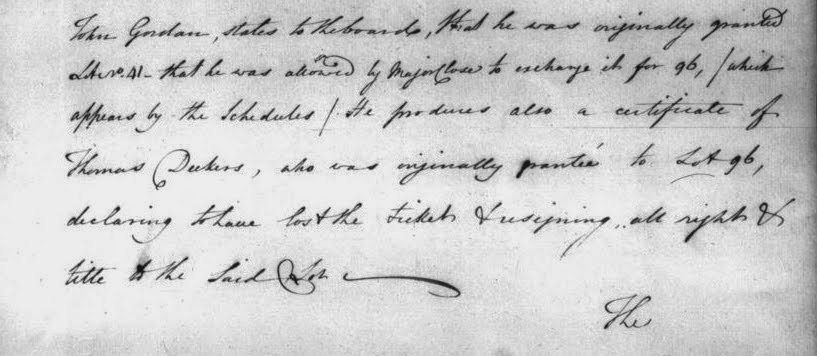
This record reads as follows:
Minutes and Records of the Land Boards Accumulated by the Executive Council Office
John Gordon, states to the boards, that he was originally granted Lot No. 41, that he was allowed by Major Close to exchange it for 96, / which appears by the Schedules / He produces also a certificate Thomas Deckers, who was originally grantee to Lot 96, declaring to have lost the ticket & assigning all right & title to the said Lot —-

Further records from Upper Canada indicate that Thomas Decker received this "ticket", or right to claim land for his service in the British Royal Army during the American Revolutionary War. 
Name: Decker, Thomas
District: Hesse
Year: 1791
Description: List of disbanded Rangers and Loyalists residing at or near Detroit
Volume: 3
Page(s): 374 [Image 582], 378 [Image 589, of Regiment 84], 391 [Image 604]; pgs 314 [Image 516], 319 [image 521] Received Provisions
Reference: RG 1 L4
Microfilm: C-14026
This page begins the list of Butler's Rangers applying for provisions.
This is the rest of the list, Thomas Decker's name appears as sixth on the list.


Thomas Decker (sixth from bottom on the list) is shown here as part of Butler's Rangers. He was employed as a laborer, and was living "In the Settlement" meaning he was living in the town of Detroit.

From all of this we can discern that in the early 1790s Thomas Decker was living in, or very near, the town of Detroit. He had received a certificate for 200 acres of land for his service in the British Royal Army. However, he had traded this land grant, that would have placed him north of Lake Ontario, in favor of a chance to purchase land on the Detroit River as part of a new settlement there. The rest of the images make it clear that he had served as one of Butler’s Rangers. 

Col. John Butler assembled his troops beginning in 1777. They were specifically assigned to coordinate their efforts with local Indian tribes, in efforts to thwart the Rebel Army's incursions into the northern colonies. Their efforts originally were concentrated in upstate New York and northern Pennsylvania, but eventually spread to as far west as Ohio and as far south as Virginia. 


Thomas Decker appears sixth from the bottom on this list.


The Upper Canada historical documents further show that Thomas Decker served in the 84th Regiment during the early stages of the Revolutionary War. The 84th Regiment of Foot came from the area of upstate New York, near Lakes Ontario and Erie. In 1 August 1778, John McDonell, who had been serving in the 84th Foot, was commissioned as a Captain in Butler’s Rangers. It is likely that McDonell managed to transfer men from his former regiment into his new group. Thomas certainly served in both the 84th Foot and Butler's Rangers with John McDonnell. 

A surprising revelation is found in this brief history of the 84th Regiment of Foot in Wikipedia:
"The 84th Regiment of Foot (Royal Highland Emigrants) was a British regiment in the American Revolutionary War that was raised to defend present day Ontario, Quebec and Atlantic Canada from the constant land and sea attacks by American Revolutionaries.[1] The 84th Regiment was also involved in offensive action in the Thirteen Colonies; including North Carolina, South Carolina, Georgia, Virginia and what is now Maine, as well as raids upon Lake Champlain and the Mohawk Valley. The regiment consisted of 2,000 men in twenty companies. The 84th Regiment was raised from Scottish soldiers who had served in the Seven Years' War and stayed in North America. As a result, the 84th Regiment had one of the oldest and most experienced officer corps of any regiment in North America.[2] The Scottish Highland regiments were a key element of the British Army in the American Revolution.[3] The 84th Regiment was clothed, armed and accoutred the same as the Black Watch, with Lieutenant Colonel Allan Maclean commanding the first battalion and Major General John Small of Strathardle commanding the second.[4] The two Battalions operated independently of each other and saw little action together."
Wikipedia Article "84th Regiment of Foot (Royal Highland Emigrants" http://en.wikipedia.org/wiki/84th_Regiment_of_Foot_(Royal_Highland_Emigrants)

That the 84th Regiment "was raised from Scottish soldiers who had served in the Seven Year's War" makes it possible that the Decker name came to America by way of Scotland. Thomas Decker may have come to America in order to serve as a Scottish Royal Highland soldier during the French and Indian War. After his service was complete, he settled along with many of the 84th Regiment in the vicinity of Lake Ontario in the colony of New York. When the Revolutionary War began, he served with the loyal 84th again, against the rebellious colonists. 

The Decker name does not seem to be Scottish in origin. Most of the Deckers in America probably came here from the Netherlands, settling in the northern colonies when they were still part of New Amsterdam. It is possible that the Decker family may have fled to Scotland from the Netherlands, or the Flemish region of Belgium, during the late 1500s, at the time when many Protestants were fleeing religious persecution for their faith. It is known that many of these people emigrated during the late 1500s, some coming to England or Scotland. The Deckers may have been part of that migration. 

Much more research needs to be done to consolidate or refute these findings. I would welcome any comments that might lead to correcting or expanding upon this information.

Tuesday, October 28, 2014

John Minear 1784-after 1860 (1110010)


John Minear was born about 1784. His birthdate comes from census estimates [he was 65 in 1850, 77 in 1860; splitting the difference, he must have been born about 1784]. In  the1850 census he claimed to have been born in Pennsylvania, and in 1860 in Virginia. He was undoubtedly born near the border between Pennsylvania and Virginia, during the time when the border was being disputed. His father was in Monongalia County Virginia (later Preston County, West Virginia) by 1789, when he purchased land on Monongalia Glade, near present day Reedsville. So, John grew up in Virginia. 


The red area on the map to the right indicates the vicinity where the Minears owned land as it would be located in modern day Preston County, West Virginia. This entire map represents counties that were originally part of Monongalia County, Virginia when it formed in 1776. Preston was still part of Monongalia in 1784, when John Minear was born. He lived in this area all of his life.


The map to the left shows the watershed area of the Monongahela River (in yellow). The Cheat River, which feeds into the Monongahela is highlighted in dark blue. This is the area where John Menear was born, and lived out his life.


In 1803, John married Catherine Fortney. There is a marriage record for this couple in Monongalia County, (West) Virginia:
Groom: John Minear
Bride: Catherine Fourtney
Marriage Date: 27 Feb 1803
County: Monongalia
State: Virginia
[Virginia Marriages, 1740-1850 [database on-line]. Provo, UT, USA: Ancestry.com Operations Inc, 1999. Original data: Dodd, Jordan R., et al.. Early American Marriages: Virginia to 1850. Bountiful, UT, USA: Precision Indexing Publishers.]


From a History of Preston County, West Virginia by Morton, Oren Frederic (1914):
[Children of] John Menear & Catherine Fortney
1. Samuel H. [b. 1805 acc to 1850 Census] m. Rachel Wadsworth 
2. Susan b. 23 Aug 1803 d. 19 Mar 1903 m John Orr
3. Henry m. Melinda Hawley
4. Keziah b. 1809 d. 1846 m. Hiram Orr
5. Elish m. Nancy Wadsworth
6. Millie m. William Moore
7. Jacob m. Elizabeth Rogers
8. Nancy m. Jonathan Fortney
9. Elizabeth m. George Morgan
10. Philip b. 1814 d. 1896 m. Sarah McKinney
11. Hiram m. (1) Phoebe Moon, (2) Elizabeth Snider
12. Solomon P. [b. 1827] m. Mary Minear 

All lineage information, including John's connection to his daughter, Nancy Jane Minear, and his father, William Minear, come from Morton’s book A History of Preston County, West Virginia. Morton’s book contained information obtained prior to 1914, from living family members. That means that these 12 children’s names came from reports from their siblings, and this is likely to be accurate information.

John can be found in Monongalia County, in the area that would become Preston, for the 1810 Federal Census: 

1810 Monongalia, VA
Jno Manier 2 m under 10, 1 m 26-44, 3 f under 10, 1 f 10-15, 1 f 16-25


Wm (William) Manier, John’s father, is found next door to him on one side and Dav (David) Manier, a brother, on the other side. Moses Manier, another likely brother, appears on the page several names above John. John would have been about 26 years of age.

Preston County formed from Monongalia County VA in 1818. The Minear family did not move, but Preston County formed where they had been living. John continued to live in Preston County for the rest of his life.

1820 Federal Census, Preston County VA (WV)

David Menear is listed two households away. There is no longer any William present. So, John’s father died before 1820. John would have been about 36 years old in 1820.


1830 Federal Census, Preston County VA (WV)

John’s brother, David Menear, is a couple of pages away.  
1840 Federal Census, Preston County VA (WV) [p. 32]


1850 Federal Census, Preston County VA (later WV)

Kazia Orr is their granddaughter, the daughter of their daughter Kezia who married Hiram Orr. Both parents had died shortly after Kazia Orr's birth, and her grandparents took her in to raise. For some reason, the Minear family was enumerated twice in 1850, as can be seen from these images. 


1860 Federal Census, Preston County VA (WV)  [House # 1767]


By 1870, he had lost his wife, and had gone to Ohio to live with his daughter Amelia (Minear) Moore and her husband William Moore. He can be found in their household in Adams County, Ohio in the 1870 Census:


His death record shows that he died in Ohio:
John Menear
Ohio, County Death Records, 1840-2001
Event Type:
Death
Event Date:
01 Apr 1875
Event Place:
Richland, Clinton, Ohio, United States
Residence Place:
Richland Clinton, Ohio
Gender:
Male
Age:
105
Marital Status:
Widowed
Race:
White
Race:
White
Occupation:
Farmer
Birth Year (Estimated):
1770
Birthplace:
Pa.


Monday, October 20, 2014

John Hiatt 1746-After 1808 (1100000)

The red oval indicates the location of the Opequan Creek. The Creek empties into the Potomac River to the north, which is the northern border of present day Jefferson County, West Virginia, but was then still part of Frederick County, Virginia. John's grandfather had purchased land in the northern part of this area in 1735.
This is where John Hiatt was born about 1746.
John Hiatt was born about 1746, in what was then Frederick County, Virginia, but is now in Jefferson County, West Virginia. His parents were John Hiatt (b. 1724) and Mary Thomas. The family were Quakers. They had moved to the area by 1735, when John’s grandfather (John Hiatt b. 1696) was granted 300 acres of land on Opequon Creek. The family became founding members of the Hopewell Monthly Meeting in Frederick County. Unfortunately, few records remain from early Hopewell church, revealing little more than the family’s presence. 


John Hiatt had relocated to Guilford County, North Carolina (see map below) by 1770, as part of the migration of many Quaker families. He appears in Quaker church records for the New Garden Monthly Meeting twice. In his first appearance, he is mentioned as having been disowned by the church for his marriage “out of unity”. This means that he had not waited for the long process that precedes a Quaker marriage. 

Preparation for a Quaker marriage involved more than just a reading of the banns for several weeks, to see if anyone had an objection to the marriage, as in other churches. Instead, a committee, generally of three men, was assigned to examine the lives of the couple. They would interview everyone who knew them, even going so far as to write to former congregations that they may have been part of to determine everyone's opinion of the couple's worthiness. 

This process generally took many months, and was sometimes known to take over a year. It is no surprise that some couples, including John & Phoebe, decided to forgo this grueling process and be married outside of the Quaker church either by a minister of another church, or a justice of the peace. John's second appearance in the records was six years later, when he had returned to the church and begged forgiveness for his "errant" marriage. 

New Garden MM, Guilford Co, NC:
29-9mo-1770 - John Hiett disowned for marriage out of unity.
30-11mo-1776 - John Hiett, Jr. condemned his marriage out of unity.

We know that he was married to Phoebe Thatcher, because in 1773 she had returned to the church and begged to be readmitted into fellowship. Since her membership records had been maintained by the Concord Monthly Meeting in Chester County, Pennsylvania, she had written to that church for their forgiveness. Her reconciliation is recorded in Concord church records. In those records, it names her as “Phebe Hiett, formerly Thatcher” which gives us both her married and maiden names. Phoebe had been attending church in Guilford County, North Carolina, and this is where she was received into fellowship at the Deep River Monthly Meeting.

Concord MM, Chester Co, PA:
4-8mo-1773 - Phebe Hiett. Formerly Thatcher, disowned some time ago, now makes acknowledgement and a recommendation received from New Garden MM [Guilford Co., NC], NC on her behalf. She removed there soon after disowned.

John and Phoebe Hiatt’s children’s births were recorded in the Deep River church records.

Deep River MM, Guilford Co, NC:
Page 19
John Hiatt
Pheby Hiatt
Ch:
John  b. 5-24-1771
Edeth  b. 10-19-1772
William  b. 11-26-1774
Pheby  b. 9-29-1776
Mary  b. 11-3-1778
Stephen  b. 9-9-1780
Martha  b. 11-22-1782 (R45)

The children of John & Phoebe (Thatcher) Hiatt are listed in the records of the
Deep River Monthly Meeting of Guilford County, North Carolina.

Shortly after their last child was born, John was again disowned. The record does not give any particulars about what his offense had been; however, from analysis of Quaker records we can get a picture of the kinds of offenses that led to disfellowship. The following is an enumeration of causes for disownment at the Hopewell MM from 1760 to 1809:

Number Offense
280 going out in marriage [“marriage out of unity”]
132 fornication
5 adultery
5 other sexual immorality
41 drinking to excess
28 a combination of offenses
22 military service
19 attending or conniving at an irregular marriage
13 quarreling or fighting
13 dancing
13 joining another denomination
9 nonattendance of meetings
4 taking the test of allegiance
3 false accusation
2 dishonesty
2 killing a mare
2 attending places of diversion
2 horse-racing
1 failing in business
1 nonpayment of debts
1 refusal to arbitrate
1 going to law
1 profanity
1 wife-beating
1 striking a man in anger
1 wounding a man
1 gaming
1 lending money for gambling
1 administering oaths
1 buying slaves
1 permitting fiddling and dancing at one's home
1 appointing meetings and preaching
[List borrowed from http://www.quaker.org/disown.html]

We can rule out the most common offenses, which were marriage out of unity, and fornication (sexual relations prior to marriage), since he was already married. If we go by the numbers, the most likely offense would be drinking in excess; however, given that the disownment took place shortly after the Revolutionary War, it is also likely that he may have been found guilty of having fortified his household, or aided the cause in some way. This was a common cause of chastisement in the day.  

Deep River MM, Guilford Co, NC:
3-5mo-1784 - John Hiatt disowned.

By 1798, both John and Phoebe had moved their membership records to Westfield Monthly Meeting in Surry County, North Carolina. 

Deep River MM, Guilford Co, NC:
2-1mo-1797 - Phebe Hiat and children granted a certificate to Westfield MM [Surry Co, NC]

Westfield MM, Surry Co, NC:
18-8mo-1798 - John Hiett received by request.

We know that they had moved to Grayson County, Virginia in 1797, because John Hiatt (called Senior, to distinguish him from his son of the same name) began to show up in tax records there. Surry County, North Carolina was just across the border from Grayson County, Virginia. Westfield Monthly Meeting, though it was across the border in another state, was undoubtedly the closest meeting to them at that time. In 1801, Mount Pleasant Monthly Meeting was organized in Grayson County, Virginia. Shortly thereafter we see that John sought reconciliation so that his membership could be moved to Mount Pleasant Monthly Meeting.

Deep River MM, Guilford Co, NC:
1-10mo-1804 - John Hiatt condemned his misconduct.
1-10mo-1804 - John Hiatt granted a certificate to Mt. Pleasant MM. [Grayson Co., VA]

Tax records in Grayson County, Virginia show us that John Hiatt continued to live there through the year 1808. At that time, many of the Mount Pleasant Monthly Meeting congregation sought for transfers to Fairfield Monthly Meeting in Highland County, Ohio. Among those who made this request, there are several members of the Hiatt family listed. John and Phoebe are not listed among them, nor is there a record extant for their being received at Fairfield Monthly Meeting. However, it is likely that they moved with the family nonetheless.

A history of Carroll County, Virginia (formed from the eastern half of Grayson County in 1842) gives the following information:
John Hiatt, Sr. sold 100 a. [acres] on Grassy Creek to Aaron Hiatt of Guilford County, North Carolina 1808

This indicates that John sold his property in Grayson County, Virginia in 1808. It seems likely that this was in order to move with his family to Ohio. He disappears from the tax list in Grayson County thereafter. No record has been found to trace him to his new home in Ohio. This is not surprising, given that there are few records surviving from those pioneer days in Ohio. The first federal census to be taken in Ohio was in 1820. John Hiatt does not appear in that census. It is probable that he had died some years before that date.

A search of tax lists, beginning in Highland County, Ohio may be necessary to narrow down the exact year of his death and to prove that he had relocated with his family.


Thursday, March 6, 2014

Isaac Cryle Decker 1829-1873 (10110)

One of the original holders of this portrait identified this as Isaac Decker Sr., however there are clues that show it unlikely that this is the case. This man is holding a leather portfolio filled with rifle cartridges. Since these type of cartridges were not used until, at least, the Civil War, this photograph must be of a man who was still rather young in the 1860s. Since Isaac Sr. would have been 65 years old by 1860, it seems unlikely that this is him. Indeed, a portrait of him from about 1870 shows him as a grizzled old man. It is more likely that it is his son Isaac Cryle Decker, who would have been thirty-one in 1860.
-----------------------------------------------------<{}>------------------------------------------------------------------


Isaac Cryle Decker was the fifth child of Isaac Decker Sr. and his first wife, Deborah. Family Search gives Isaac's birth date as February 18, 1829 and death date as Between 1874 - 1876, but I'm uncertain of their sources for this information. Census data confirms the year of birth (1829) and gives his birthplace as "Upper Canada." This did not mean that he was born in the northernmost reaches of the Canadian border. The phrase "Upper Canada" was used by early Americans to designate an area along the "upper" (or western) portion of the St. Lawrence River. This included the area around the northern borders of Lake Ontario and Lake Erie. The "upper" portion being "up river" from the lower (or eastern) portion, was what made early settlers call the southernmost part of the modern Province of Ontario "Upper Canada."


Isaac may have indeed been born in Ontario, Canada, however it is also possible that he was born in Michigan, near Detroit. Lizzie Decker (his daughter), in the 1900 Census, said that her father was born in Michigan.  Isaac Decker Sr., Isaac Cryle Decker's father, purchased a couple of large tracts of land in Michigan in the early 1830s, so he may have been a resident in the state prior to 1830, when Isaac Cryle Decker was born. Since Michigan was a Territory at this period of time (from 1805 to 1837), not yet a state, and had been within British jurisdiction, it may still have been considered as part of Upper Canada.

Isaac Cryle Decker moved to Texas with his family about the time his father had qualified for a league of land (4,228 acres) in Ben Milam's colony on 17 Mar 1835 (present day Travis County). A few years later, due to trouble with Indian attacks, Isaac Sr. sold his Milam County land, and was granted a labor of land (177 acres) in Montgomery County, Texas.  One can only imagine the terror that drove the family to abandon their newly built home and move to a more populous area, but it must have been a hard decision to make.

Isaac Cryle Decker can be found in the 1850 Census living with his father and his step-mother (Isaac Sr.'s second wife Ann), in Montgomery County, TX. Though he is listed in his father's household, he has $600 worth of acreage of his own.  He also shows up on the tax lists for Montgomery County from 1850 through 1873 when there is a break in the tax list. His family lived in the vicinity of Tillis Prairie, in Decker Prairie which his father founded. Decker Prairie is now an unincorporated rural district of homes, with an elementary school, and community center, and it still retains the pioneer family's name. The old cemetery where Isaac Decker Sr. and his family are buried is still intact.
1850 Census: Isaac C. Decker, in his father's household, Montgomery County, GA.

Isaac married Rachel Elizabeth Sanders, daughter of Claiborne B. and Nancy (Holder) Sanders, in Montgomery County TX on 26 Dec 1855. They were married by Lemly Clepper, a justice of the peace.

They had the following children:
1) Almira Elizabeth Decker b. 10 Jan 1857 Montgomery TX, d. 1 Nov 1913 Brownwood, Brown, TX; m. James Andrew Gilley 3 Feb 1875 Waller, TX
2) Ophelia Jane Decker b. 20 Sep 1859 Montgomery, TX; d. 15 May 1939 Hageman, Chaves, NM; m. Andrew Austin Andrus.

A quote from the 1974 Decker Prairie Year Book states that 'This family lived in Decker Prairie for awhile but possibly moved "back north" in later years.'  The fact that the couple do not appear in the 1860 Federal Census in Montgomery County might explain the speculation. However, we know from Montgomery County tax lists that they lived in the area from 1850 through 1873, since Isaac C. Decker is listed as a neighbor to his father up to his father's death. We also know that Isaac and Lizzie were in Texas for the Civil War.

Isaac was not only in Texas during the Civil War, he enlisted in the Confederate Cavalry on 14 May 1862, as a Sergeant in Waller's Regiment, Company D, 13th Battalion. He served until the end of the war.


Name:
Isaac Decker
Side:
Confederate
Regiment State/Origin:
Texas
Regiment Name:
Waller's Reg't Texas Cavalry
Regiment Name Expanded:
Waller's Regiment, Texas Cavalry
Company:
D
Rank In:
Sergeant
Rank In Expanded:
Sergeant
Rank Out:
Sergeant
Rank Out Expanded:
Sergeant
Film Number:
M227 roll 9
[National Park Service. U.S. Civil War Soldiers, 1861-1865 ]

History has been rewritten to reflect only the Union side of the Civil War. If you read the Wikipedia article, for example, it fails completely to reflect the southern side at all. They have insisted the war was about ending slavery. That was only a small part of what the war was about, and for most soldiers (both North and South) was not significant at all. Indeed, the emancipation of slaves was not even made an explicit part of the war effort until the Lincoln signed the Emancipation Proclamation on 1st January 1863.

The North was largely an industrial economy, which gave them an advantage in liquid assets. They were also more populous, which gave them an advantage in votes in congress and for the presidency. When congress met to decide issues involving all states, the North had become dominant in every major issue. The South began to feel that they were being unfairly taxed to support causes that benefitted only the North. It was a situation of taxation without representation. The North continued to increase taxes on land, crippling the Southern economy, in order to build infrastructure in the North. The situation was rife for contention. The South decided that the only way that they could maintain their rights of representation in congress was to secede from the union and form their own nation. This was the real initiating cause of the Civil War.

In the March 1862 edition of the Houston Tri-Weekly Telegraph Waller published the following plea for good men to join the fight:

“Regiment of Mounted Men for three years or the war, were at home on horseback, who ride like cowboys, who hit the bull’s eye with a rifle or pistol, and go anywhere and stand anything like a regular Ranger.  Recruits are requested to bring their Arms when they have suitable Guns, Pistols, etc. . . . They are also requested to bring their Horses . . .
Texians your homes and hearthstones are now threatened from the North.  You are called to the rescue . . . Come now, come at once, come to the rescue and let us win our liberties by our valor.  Here is a service that Texians delight in.  This Regiment like the brave Rangers of Terry’s [8th Texas Cavalry] will be assigned duty in the teeth of danger. Come with me, and I will lead you right when your habits and disposition will enable you to make the best fight in your power.”

Waller was warning men that their "homes and hearthstones" were threatened by a northern invasion. The Union Army was threatening to invade Texas by way of Arkansas and Louisiana which they were in the process of conquering. Isaac C. Decker was among the men who answered the call. An army was invading his homeland, and threatening the peace of his family. Isaac owned no slaves, and did not fight for the cause of keeping slavery. He was fighting for the right of his state to determine their own future. He readily signed up for Waller's regiment.

The history of the 13th Battalion tells us that they traveled into Arkansas early in 1862, where they set up camp and built defensive earthworks near the Arkansas River to keep Union forces at bay, but after many weeks the Union forces failed to materialize and the battalion moved south into Louisiana.  Waller's Regiment had reached Louisiana by July 20th, here they made camp at a sugar mill near the Mississippi River, and began to make a general nuisance of themselves by burning a schooner and its cargo, and another boat stranded near Algiers. They continued to scour the countryside, intercepting Union provisions.

It was on 7 Sep 1862 that they had their first encounter with the Union army at Bonnet Carre. Things went badly for the Confederate Cavalry there; and, along with most of the other men, Isaac lost his horse and was forced to regroup with the rest of the battalion several miles away. The following is a voucher reflecting that Isaac lost his horse and his gun, as well as other equipment, in that retreat.


Union Major General Benjamin Butler became angry at reports of the depredations that were being caused by Confederate forces. He became determined to put an end to it. However, the event that finally galvanized him into action actually had nothing to do with Waller's Regiment. It was an attack on the 8th Vermont Infantry, that was the responsibility of Confederate General John Pratt, who was in charge of the Louisiana militia. Pratt had ignored a white flag of truce, and attacked the Vermont Regiment, taking many prisoners. 

General Butler mistakenly attributed this cowardly act to the Texans, instead of the Louisiana militia. He was so angry at this injustice that he decided to launch an attack directed specifically at Waller's Regiment, in order to put them permanently out of commission. Over four battalions of Union troops were assembled near Carrollton on September 8th, 1862 to begin the assault. The Confederates were outmanned six to one, and the Union army also included two battalions of artillery of which the Confederates had none. The result was a disaster for Waller's men.

William Craig, a Confederate soldier with Waller’s Regiment, wrote the following:
“They saw the boats leave Carrollton about 1 o’clock at night and they supposed they were coming up to give us a fight and they hurried with the greatest dispatch to inform Col. Waller of the fact and reached camp about daylight.  The whole command was formed in a few moments and we were marched into a cane field and here we waited until the boats had moved on us and then the transports landed their men . . . While marching on, their guard fired on our advance and killed three men . . . but they were hid in the cane and our men could not fire . . . [We] pushed on but could not find ground sufficient to form in line of battle mounted so all were dismounted and then every forth man had to hold horses.  We then marched about 100 yards and all were stationed along side of the road awaiting an attack . . . then they opened on us with their Battery & Minnies and Waller gave the order to fall back to our horses amid Shells &balls!  We retreated down the canal and here we come to the Swamp and Col. Waller finding it impossible to take our horses into the swamp, commanded all to leave their horses and take it afoot.  Some led their horses in two or three miles but finding that they could go no further left them.  By this time the command was very much scattered and in all directions.  Col. Waller . . . Major Boone and almost all of the Captains had squads all day in getting through the swamps and some arrived at the station about noon and another squad arrived about sundown.  All wet and hungry and remarkably tired.  Some came in with no shoes on, no hats and some with hardly any clothes.”

In another account of the skirmish, a letter printed in the Bellville Countryman [Vol. 3, No. 12, Ed. 1] Saturday, October 18, 1862, William P. Jackson wrote that there were two gunboats in the river beside them “keeping opposite to us, watching our movements. This boat had two masts, on the foremost stood a man with a spyglass so that he could see all our movements and count our number…Boom came the shells all over us—bursting some fifteen or twenty inches above our heads;—doing us no damage, however, but scaring us pretty badly, and our horses worse…We now arrived at a large ditch near the swamp, which we immediately crossed and were then ordered to dismount, and one man hold eight horses.”

They walked down the ditch and through the sugar cane, before halting and assembling in preparation for a charge by the enemy line. Jackson continues, “Col. Waller walked out where he could see them, and said: ‘Boys, that line is two miles long.’ Just at this time some one came up and told him they were out-flanking, and getting between him and the swamp. He then ordered us to get to horses. Just as we started they commenced firing at us with four pieces of artillery."

A more official account was published in the Tri-Weekly Telegraph (Houston, TX) [Vol. 28, No. 81, Ed. 1] Monday, September 22, 1862:
The Boutt Station Fight: Narrow Escape of Waller’s Command
“On Sunday, 7th inst., we went to Boutt Station and took possession; but finding no water for our horses, we returned up the river about five miles, to a sugar plantation, where we seized two schooners, loaded with sugar and molasses which we burned. On Monday, the 8th, at daylight, there appeared four transports and the man-of-war Brooklyn, about four miles below, coming up. We saddled up and returned into the sugar field, where we waited until two of the transports landed below us, and the other two at once came on up and landed about two miles above us, and put off about 1500 infantry, and two batteries of artillery, which at once formed and came forward into the cane-field just above us. We struck down nearer the swamp, and attempted to move up the river, when suddenly our advance was fired upon, killing three or four men. We then retreated to the rear of the sugar field, and between it and the swamp. the Brooklyn was shelling us heavily the whole time. We first formed on horseback, but found the ground unsuited for cavalry charge,—We then left our horses and went forward on foot, when the enemy suddenly fired on us from ambush, attacking both flanks with shells, grape, canister and musketry. We stood our ground firmly, expecting the enemy to advance, until we observed a force striking between us and the swamp, with the intention of surrounding us; and at the same time discovered the number of the enemy to be much greater than we at first thought—1200 or 1500 more moving upon us from the transports which had landed below. Major Boone at once ordered a retreat to the swamp, which most of us reached, with our horses, under heavy fire. After getting into the swamp, Major Boone and Col. Waller concluded that the only alternative was to surrender, or leave our horses and try to make our escape through the swamp on foot. We chose the latter; and after some delay, during which time we were shelled incessantly, we started on our way through the swamp. On Tuesday, the 9th, near night, after terrible suffering, we reached the camp, on Bayou Desalmarede, with only 140 men, since which one 50 others have arrived at Thibodaux. Our whole number which went into the fight was about 250 men. The enemy had about 3,000 infantry and artillery, and 500 cavalry. Some of our missing may yet turn up. T. Hensly, A. Q. M.”

The Union troops pursued the Confederates, coming across about 300 horses mired up to their bellies in mud. Some of them had fallen in trying to extricate themselves, and had been empaled by Cypress knees growing out of the mud. The Union soldiers continued to pursue, shooting at the retreating men until they had captured the few who were within their firing range, but they soon realized that it was useless to continue further.

Waller's Regiment regrouped, and camped. After careful consideration, Waller allowed one man from each company to return to Texas in order to gather weapons and horses to resupply the men. In the meantime, most of the regiment were ferried about in cane carts from camp to camp. The Union soldiers began to call them the "cane cart company," adding to their humiliation. Waller's Battalion was effectively taken out of the fighting for the rest of the year, while they waited to be resupplied.

A severe early winter took its toll on the troops through illness late in 1862, typhoid fever, pneumonia, and tuberculosis broke out in epidemic proportions among the weakened troops, and two men died from exposure in the blasting winter chill. Fortunately, new supplies reached them before they had lost many men. These supplies included tents, blankets and warm clothing as well as fresh food. The rest of the winter was milder as well, so that they were able to get through without further losses. 

By Spring, the 13th Battalion was equipped and ready to join the fighting. They were anxious to overcome the enemy, to prove that what happened at Bonnet Carre had been merely a temporary setback. In April of 1863 they were ordered to engage the Union forces to offer relief to Vicksburg, which was under siege. In order to do so, they would storm Fort Buchanan where enemy supplies were being delivered.

They had to cross a lake, twelve miles long, in flimsy skiffs, then slog through several more miles of waist deep swamp during the middle of the night, before reaching the enemy. The following clipping gives an account of the storming of the enemy encampment:

Dallas Herald. (Dallas, Tex.), Vol. 11, No. 33, Ed. 1 Wednesday, July 15, 1863.
Their reputation made good, they continued to encounter the Union army north of Vicksburg and skirmished with them at Bunch's Bend, where they captured many prisoners as well as supply wagons. On 9 June 1863, they encountered the Union army again at Lake Providence, but the battle was indecisive. 


This map shows location of the Battle of Pleasant Hill in Louisiana. Just above it is Mansfield, where the battle had been waged the previous day. [Map from Johnson, Robert Underwood, and Clarence Clough Buel. Battles and leaders of the Civil War. Vol. IV. New York: The Century Co., 1888.]

There were no further encounters that year, and the men finally settled into winter quarters. In the following spring they had their worst encounter yet with the Union forces at the battles of Mansfield on 8 April and Pleasant Hill on 9 April in 1864. The Union forces retreated, and the Confederates followed them north to Jenkin's Ferry where they engaged them in battle again. Things went badly for the Confederate forces there, but the battle was indecisive. This was the final battle that the 13th participated in. They were stationed again in Louisiana and Arkansas where they were involved in building bridges and patrolling river routes, before returning to Texas. The entire battalion was on leave just before the war ended.

Isaac went back to his farm, and continued to live on Decker's Prairie until his death. He appears in the 1870 Census in Montgomery County, Texas.

Isaac C. Decker in 1870 Census, Montgomery County, TX

I have yet to locate a cemetery record, obituary or probate records to confirm his death date, but former researchers have his death in Sep of 1873. There may be a grave marker for him in Decker's cemetery that has yet to be transcribed. If he did die in 1873, he was still quite young at the time, at just 44 years of age.
