Tuesday, November 11, 2014

Peter Rough before 1765-1825 (11101000)

Beautiful Augusta County, Virginia where Peter Rough lived throughout his adult life.

According to census data, Peter Rough was born before 1765. The same census data gives us the spelling of his surname as Rough. The first records we have found for him were tax lists in Augusta County, Virginia beginning in 1788, where his surname is also generally rendered as Peter Rough. However, the Lutheran church records in which he appears render his surname in the original germanic spelling of Rausch. 
Augusta County, Virginia

His parents have yet to be identified. It is possible that he is part of the Rauch family of Pennsylvania. Dellynn Leavitt has identified his father as Johan Georg Rauch (b. 1669 Oderheim, Rheinland-Pfalz, Germany). Johan George was in Berks County (Albany Township), Pennsylvania until 1765, and thereafter in Northampton County, Pennsylvania. Leavitt says there are two men named Peter Rauch in that family line. The one he has identified as the same as the Peter Rough of Augusta County, Virginia is a son of Johan Georg Rauch. The other Peter Rauch that he has identified was a grandson of Johan Georg, through his son George Rauch. One Peter stayed behind in Lehigh County PA, while the other seems to disappear from the PA records, and therefore may be our Peter who shows up in Augusta County, Virginia by 1788. 

The church records in Northampton have the following information for Peter Rauch:
Northampton (later became Lehigh) County PA
RAUCH, Johannes, s. Peter RAUCH and w. Margreth; b. Jan. 14, 1773; bap. Feb. 14, 1773; sp. Johann Theobald HERZOG and Eva Catharina SAEGER.
RAUCH, Susanna, dr. Peter RAUCH and w. Anna Margreth; b. Aug. 4, 1774; bap. Sept. 4, 1774; sp. Johannes GROB and Anna Maria LEISINRING.
RAUCH, Catharina, dr. Peter RAUCH and w. Anna Margreth; b. Nov. 10, 1776; bap. Feb. 2, 1777; sp. Christian SAEGER and w. Maria Susanna.
Pasted from <http://files.usgwarchives.org/pa/lehigh/church/egyp0001.txt>


One similarity between the two is that both Peter Rough of Augusta County, Virginia and Peter Rauch of Northampton County, Pennsylvania had sons named John (Johannes) and daughters named Susanna. No record of a Catharina has been found in Augusta County, Virginia. Several other researchers have followed Leavitt’s lead in identifying Johannes and Susanna as the same as those who later show up in Virginia.

Another similarity is that both Peters have wives named Margaretta. Peter of Northampton County PA has a wife identified as Anna Margreth in the church records. The Peter of Augusta County has a wife identified as “Grata" (another spelling of Gretta) which is undoubtedly short for Margaretta. These similarities have led several researchers to follow Leavitt’s lead in identifying the Northampton County group as the same family as those who later show up in Virginia.

However, I find it difficult to believe that this is the same family, in spite of these similarities. For one thing, the children born to the Peter of Northampton PA seem to be born several years earlier than the ones in Virginia. The similarities can be explained quite simply considering that the Northampton County, PA family may be related to Peter of Augusta County, VA. In that case, a common naming pattern would run in the family. In addition, the name Margaret was one of the most popular female names in all germanic records, second only to Maria. So, the similarity in the wives’ names here is not necessarily anything more than pure coincidence. 

Last of all, and most difficult to reconcile is that the Peter in Northampton PA shows up on a tax record there in 1793, while Peter of Augusta VA is in Virginia by 1788 where he shows up consistently on tax lists there. It seems unlikely that he would have maintained two residences so far apart.

The other, more likely possibility is that Peter is part of the Johann Adam Rausch family of Shenandoah County VA. They are closer in vicinity, being just a county removed from Augusta County, where Peter settled with his family. Some of Johann Adam Rausch’s children are said to have been born in the same decade as Peter, which makes it possible that they were siblings. All researchers on this family line claim that not all of the sons of Johann Adam have been discovered yet, leaving the possibility open for Peter to have been a son. However, no record has yet been found for Peter in Shenandoah County. 

The name is rendered as Roush in most records of the Shenandoah Valley. Though the 1782, 1783 and 1785 tax lists are readily available for Shenandoah County, Virginia, and they list several Roush men. Peter does not show up in those tax records. However, given the many “white souls” enumerated within the Roush households, it is possible that Peter may have been one of the number.

Roush Heads of Family Enumerated in 1783:
Henry 5, Phillip 10, George 3, Jacob 5, John 7, John Jr. 4 & Sr. 2 Daniel 2

Roush Heads of Family Enumerated in 1785:
John 6, Daniel 2, John 3, Henry 5, John Senr 3, Philip 10
[Numbers following names are “white souls” enumerated in each household.]

Researchers on this Roush family of the Shenandoah Valley have not found enough information to identify everybody who is referenced in these tax lists. One significant omission in their research is an explanation of why there are three John Roushes listed. They claim that the John Roush Junior listed is the son of John Roush Senior. However, another possibility is that there are three generations represented. John Junior might be a grandson of John Senior, the third John Roush being the son of John Senior. 

John Roush Senior was born about 1711. He could have been having children as early as the early 1730s, yet the earliest birth they have identified for any of the children is in 1741. This means that John Senior’s grandchildren may have been born as early as the 1750s. Since Peter Rough was born before 1765, he may just as easily have been a grandson to John Roush Senior. 

Yet a third possibility is that Peter Rough may have come from Chesterfield County, Virginia. There are a John Rough who left a will in Chesterfield County in 1755 and a George Rough who left a will there in 1756. All of the above possibilities deserve further study, as they may lead to identifying the parents of Peter Rough.

Peter Rough first appears on the tax rolls in Augusta County VA in 1788. In 1791, he shows up in court for the following:
Peter Rough vs. Jacob Teeford.--Assault and battery on Susanna Rough, daughter of plaintiff, 1791. [If she were born in 1774, she would have been 17 years old.]

In 1798 he was present at his daughter's wedding in Augusta County:
1798---October 16, Edward McFadden and Chrisn. Lukenbill, surety.
Edward McFadden and Susannah Rough, daughter of Peter Rough (Rowitz, Rausch) (consent).
[From CHRONICLES OF THE SCOTCH-IRISH SETTLEMENT OF VIRGINIA; Vol 2, pp 320-329 by Lyman Chalkley] [If Susannah was the Susanna born 1774 in Northampton County, PA, then she would be 24, and not likely in need of parental consent.]

He also sponsored a baptismal candidate:
St. John's Church Register German Reformed & Lutheran Augusta County VA 1786-1872:
p. 12 4 Jul 1798 I bapt. A son for Adolph Weissman. Name Johann Jacob. Born 28 Nov. Peter Rauch & wife Grata spons.
[This record names Peter's wife as “Grata."]

Chalkley also reveals a second daughter married shortly afterward:
1799--November 27, Mathias Fox [sometimes rendered Fuchs] and John Mount, surety. Mathias Fuchs and Peggy Rauch, daughter of Peter Rauch (consent in German).
Teste: John Rauch.

"Peter Rough" in Augusta County, Virginia for the 1810 Census.

1810 Census
Peter Rough, Jr 1 Male 16-26 yrs,  1 Female under 10, 1 Female 16-26 yrs
Geo Rough 2 Males under 10 yrs, 1 Male 16-26 yrs, 1 Female under 10 yrs, 1 Female 16-26 yrs
*Peter Rough 2 Males 16-26 yrs, 1 Male 45 and up, 1 Female 45 and up
John Rough 1 Male under 10 yrs, 1 Male 26-45 yrs, 1 Female under 10 yrs, 1 Female 16-26 yrs
[b. 1765-1784]

"Peter Rough, Sen" in Augusta County, Virginia for the 1820 Census.

1820 Greenville, Augusta Co, Virginia Census, page 13A
*Peter Rough, Sr 1 Male 45 yrs and up, 1 Female 45 yrs and up
Peter Rough 3 Males under 10 yrs, 1 Male 26-45yrs 2 Females under 10 yrs, 1 Female 10-16 yrs, 1 Female 26-45 yrs, 1 person of this family in agriculture
George Rough 4 Males under 10 yrs, 1 Male 10-16 yrs, 1 Male 26-45 yrs, 2 Females under 10 yrs, 1 Female 16-26 yrs, 1 person of this family in agriculture
David Rough 1 Male 16-26, 2 Females under 10 yrs, 1 Female 16-26 yrs, 1 person of this family in commerce

The records indicate that he had five sons, and at least two (perhaps three) daughters:
1) John Rauch b. 1780-1790 [according to 1830 Census]
2) Susannah Rauch b. may have been as late as 1782, m. Edward McFadden 16 Oct 1798
3) Margaret Rough b. bef. 1781, m. Mathias Fox/Fuchs 27 Nov 1799
4) George Rough b. abt. 1784, m. abt 1806 Augusta, VA
5) Peter Rough Jr. b. bet. 1784-1790
6) David Rough b. abt. 1794
7) Unidentified male

Peter disappears after the 1825 tax list. Peter Jr. shows up in the 1830 census no longer designated as Jr., so it is probable that Peter Rough Sr. died about 1825.


Sunday, November 9, 2014

George Rough 1789-after 1860 (1110100)


George Rough was born about 1789 in Augusta County, Virginia to Peter Rough/Rausch and his wife Margareta (whose maiden name is not yet known).  Combining the first three census birth ranges we can see that he was born between 1785-1790. In 1840, he is enumerated as born between 1771 and 1780. In the 1850 Census, it says he was 69, so born about 1781. This seems a bit early considering that he does not show up on the tax lists in Augusta County until 1810. If he was 21 in 1810 (the age at which a young man began to be taxed), he would be born about 1789, which fits the data from the first three censuses well. Considering the primacy of the tax list, this makes it more likely that he was born about 1789. The 1860 Census gives his age as 70 years, so born 1790. This too is more in keeping with a birth in 1789. 

Children identified for George Rough and wife, Sarah (maiden name unknown):
Henry Rough b. 1807 Augusta, VA [Henry is questionable, may have been a nephew]
David Rough b. 1810 Augusta, VA; m. Phebe E. S. Reed 3 Sep 1833 Bath County, VA; d. prob. bef 1860 Highland, VA
George Jr. Rough b. 1812 Augusta, VA m. Polly Williams  17 Sep 1835  Bath County VA
John Rough b. 1813 Augusta, VA; d. aft 1844 Bath VA [last appeared on tax list]
Sarah Rough b. 1814 Augusta, VA; m. James Williams 2 Aug 1832 Bath  County VA
Mary Rough b. 1815 Augusta, VA; m. John Murphy 23 May 1844 Bath  County VA
Christian Rough b. 1816 Augusta, VA; m. Elizabeth Brinkly 31 August 1835 Bath County VA
James Rough b. 1817 Augusta, VA; m. Jane Ross 26 Jun 1849 Highland County VA
William Rough (AKA Rowe) b. 1822 Augusta, VA Martha Williams 12 Jan 1842 Bath  County VA
Joseph Rough b. 1823 Augusta, VA m. Lucinda Long 6 Jun 1843 Pendleton  County VA
Margaret Rough b. bet. 1820-1825 Augusta, VA; m. Adam Jackson 8 May 1841
[There may have been another son born between 1801 and 1810, who was left back in Augusta County when the family moved to Bath County.]

George Rough can be found in the 1810 & 1820 Census in Augusta County VA, living next to his probable father Peter Rough, Senior. Peter Sr. is the only male old enough to be father to this generation of Roughs, and also lives near them all, so this likely connects George to his father.

Geo Rough in August Virginia for the 1810 Census. As difficult as this is to read in its faded condition, the same order of family names appears in the 1820 Census to show that this was the correct family.

1810 Census Augusta VA
Geo Rough 2 m under 10, 1 m 16-25, 1 f under 10, 1 f 16-25 [b. 1785 to 1794] 
Peter Rough 2 m 16-25, 1 m over 45, 1 f over 45
[Neighbors include Peter Rough Jr., Geo Rough (above), John Rough]

George Rough in Augusta County, Virginia for the 1820 Census.

1820 Census Greenville, Augusta, VA
George Rough 4 m under 10, 1 m 10-15, 1 m 26-44, 1 f under 10, 1 f [b. 1776-1794]  
Peter Rough Senior 1 m over 45, 1 f over 45
[Neighbors include George (above), David, and Peter Jr.]

Map showing the vicinity of Greenville (red dot)
in Augusta County, Virginia.

This 1820 Census shows that George, his father and siblings lived in the vicinity of Greenville, which is still in present day Augusta County VA. By 1827, George had moved to Bath County VA, where he appears in the next Federal Census. 

George Row in Bath County Virginia for the 1830 Census. His name is at this point being rendered Row, as his sons' names will also be rendered in later census records.

1830 Census Bath, VA
George Row 2 m 5-9, 2 m 10-14, 2 m 15-19, 2 m 20-29, 1 m 40-49, 1 f under 5, 2 f 15-19, 1 f 40-49 [b. 1781-1790] 
[No other Roughs or Rowes in Bath]

George Rough in the 1840 Census in Bath County, Virginia. Yet again, it is being rendered as Rough.

1840 Census Bath, VA
George Rough 2 m 15-19, 2 m 20-29, 1 m 60-69 [b. 1771-1780], 1 f 5-9, 1 f 10-14, 1 f 50-59
[There is a George Rough who is between 20 and 30 years old, living in neighboring Pendleton County VA during the 1840 Census. This is undoubtedly George Rough Jr.]


In 1847, the part of Bath County that George lived in had become Highland County VA, so he can be found in Highland County, living with his son George Jr. and family in the 1850 Census. On 18 Dec 1856 he was grantor on a deed in Highland County VA.


Highland County VA Deed Book 2 p. 487:
18 Dec 1856 Grantor: 
Rough, George
Grantee: 
Amos R. Ball
Pers Trust 2 487

In the 1850 Census:
George Rowk as his name is rendered for the 1850 Census in Highland County, Virginia.
Here he is in the household of son, George Junior.
In the 1860 Census, he is found in Highland County, Virginia living with his son Joseph:
George Rowk in the home of son, Joseph Rowk, in Highland County, Virginia for the 1860 Census.

He is called George Rowk Sr. "Grandfather", 70 years old (b. about 1790) born in Highland County VA. The fact that he is called grandfather in this census suggests that the informant was one of Joseph's children, and not Joseph himself as head of household. Sarah is already gone.

Joseph Rough's death record names his mother, the wife of George Rough Sr., "Sally" a common nickname for Sarah. However, it doesn't give her maiden name:

Name: Joseph Rough 
Gender: Male 
Burial Date:
Burial Place:
Death Date: 23 Sep 1861 
Death Place: Crabbottom, Highland, Virginia 
Age: 45 
Birth Date: 1816 
Birthplace: Augusta County 
Occupation: Farmer 
Race: White 
Marital Status: Married 
Spouse's Name: Lucinda Rough 
Father's Name: George Rough 
Father's Birthplace:
Mother's Name: Sally Rough 
Mother's Birthplace:
Indexing Project (Batch) Number: B07495-9
System Origin: Virginia-EASY 
Source Film Number: 31997 
Reference Number: p12 #7 


No other records have been found for either George or Sarah Rough at this time. More research needs to be done to locate a grave marker, or death record, if possible. At this point, we can only say that he was still alive in 1860.


Saturday, November 8, 2014

William Rowe 1822-1893 (111010)

Tracing William Rowe’s family has been a devilish task which had eluded several researcher’s efforts. From 1870 and 1880 Census data, we can get a birth year estimate of about 1822. From the same data, it was safe to conclude that William, his wife and his children were all born in Virginia, though this still left the county from which they derived a mystery. Exhaustive research into the Rowe families of Virginia proved disappointing. It was only after searching for possible alternate spellings or possible mis-transcriptions of the name Rowe, along with search engine “wild cards” to discover the broadest scope of possibilities, that I was able to be trace William to Highland County Virginia.

William appeared in Highland County in the 1860 U.S. Census as William Rouk. It was unmistakably the same family, given that Martha and all of the children’s names were correct, and ages were appropriate. Also living in Highland County for the 1860 Census was a Joseph Rowk. The census data says that all of family were born in Highland County VA, but Highland County didn't exist before 1850. Half of it was Bath County (South) and half Pendleton County (North). However, they were undoubtedly born in the part of Bath County that had become Highland County by the time the census was taken.

Also found in the 1860 Census in Highland County is a George W. Rouk and his family. George is undoubtedly William's brother, since his family also moved to West Virginia around the same time that William moved there. William and George Jr. also married sisters, Mary "Polly" and Martha Williams, which is strong evidence of their relationship. In the 1850 Census, George W. Rouk has a George Sr. living with him, who is undoubtedly the patriarch of the family. 

After studying early records from Augusta County, Virginia, it became clear that the original name of the family was German, and spelled Rausch. The name Rowe was pronounced to rhyme with Cow or How not Mow or Tow. The final sound would be the softer Germanic CH sound, made at the back of the throat. In Augusta County records it is sometimes spelled Rowk or Rouk, but was most commonly spelled Rough. This was not pronounced Ruff, as we would pronounce it today, but was rendered this way to rhyme with Plough (the earliest version of Plow). 

The Scottish people who dominated the county may even have given the word Plough a guttural ending much like the Germanic CH. In changing from Rauch to Rowe, they were merely dropping the final CH sound, which was probably difficult for their new English neighbors to pronounce. The name was undoubtedly still pronounced to rhyme with Cow, since contemporary descendants from this family line assure me that it is still pronounced this way today. 

Rauch is the German word for Smoke. It is unknown whether the family name derived from the production of tobacco products (which were introduced to France in 1560, and consequently traveled throughout Europe), or from the preservation of meat in a smokehouse. There has also been some conjecture that the name may have come from the same root as the German word Rauchwaren, which refers to Fur worn as a garment--Waren meaning wearing apparel, and Rauch meaning Hairy or Furry. The advocate for this theory maintains that a strong, hairy man was a common heraldic symbol to represent fierce fighters. 

The following gives marriage record information for William and Martha:
Groom Name: William Rough
Bride Name: Martha Jane Williams
Marriage Date: 12 Jan 1842
County: Bath
State: Virginia


Chackley has confirmation of this:
Name:William Row
Date:30 Jan 1840
Notes:This marriage record was originally published in "Chronicles of the Scotch-Irish Settlement in Virginia, 1745-1800. Extracted from the Original Court Records of Augusta County" by Lyman Chalkley.
Description:Spouse


In 1850 there is a Rough family with William Rough as a head of family (b. abt 1818), Sally as the wife and a daughter Alice aged 6. I cannot locate this family in any previous or subsequent records in the area. Nor can I find my William (b. 1822), Mary and the four children who were born before 1850 anywhere in the area. All I can think is that the enumerator somehow confused William with another family, so listed the wrong wife and child for him.

"William Rowk" and family in the 1860 Federal Census in Highland County, Virginia.

1860 Census Highland County, VA
William Rowk 36 Farmhand, born Highland Co. VA
Martha J. 36 36 Housewife, born Highland Co. VA
Alphius E. 16 Farmhand, born Highland Co. VA
Jeremiah J. 14 born Highland Co. VA
Mary M. 12 born Highland Co. VA
William A. 10 born Highland Co. VA
James H. 7 born Highland Co. VA
Peter N. 3 born Highland Co. VA
Sarah E. J. 2 born Highland Co. VA

The railroad came to Preston County (then Virginia, now West Virginia) in 1852. The iron industry followed shortly after that. Industrial jobs paid much better than farm labor, and were a more reliable source of income, which explains William's change of occupation from farmhand to coke burner upon moving to Preston County. Coke was burned in the production of steel, since it burns at a higher heat than coal. William's work involved keeping the blast furnaces burning.


William Rowe/Rough probably moved to Preston when the Civil War began in 1861, to get work in the iron foundry. Steel was in great demand during this era of railroads and rifles. Great fortunes were made by the owners of these works. War makes for good business, if you position yourself carefully.


It is unknown whether William Rowe participated in the war, beyond his work at the foundry. There are a couple of William Rowes who did serve, one on each side of the conflict. Rowe was an extremely common name in Virginia at the time, and William was the second most popular male name after John. So, it is unlikely that either of these is our William. But just for informational purpose here is the information on these two men:

U.S. Civil War Soldiers, 1861-1865 
about William A. Rowe Jr. 
Name: William A. Rowe Jr. 
Side: Confederate 
Regiment State/Origin: Virginia 
Regiment Name: 21 Virginia Militia 
Regiment Name Expanded: 21st Regiment, Virginia Militia 
COMPANY: A 
Rank In: Second Lieutenant 
Rank Out: Second Lieutenant 
Film Number: M382 roll 48 

American Civil War Soldiers 
Name: William Rowe 
Side Served: Union 
State Served: West Virginia 
Service Record: Enlisted as a Sergeant.
Enlisted in Company C, 5th Infantry Regiment West Virginia.
Promoted to Full 2nd Lieutenant on 1 May 1862.
Mustered Out Company C, 5th Infantry Regiment West Virginia on 9 Nov 1864.
Sources: 304,79 

There is a William C. Rowe who "Mustered out" in May 22, 1862, listed on the Adjutant General's annual report. He is in the 5th Regiment Company C, so probably the same as the second William above. [The 5th Regiment was mustered in at Ceredo, Wayne County WV. Wayne County is where a lot of Rowes lived, so was not likely our man.]

William Row with family in the 1870 Federal Census in Lyon District, Preston County, West Virginia.

William can be found in the Lyon District, Preston County WV in the 1870 and 1880 Census. 
1870 Census Lyon District, Preston County, WV
William Row 45, occupation--Burning Coke, born VA
Martha J. 44 Keeping House, born VA
William A. 20 Underground Driller, born VA
James A. 17 Breaking Oar, born VA
Peter M. 16 Breaking Oar, born VA
Sarah S. 10 at home, born VA
John 9 at home, born VA
Martha J. 6 born WV
Louisa B. 4 born WV

William Rowe and family in the 1880 Federal Census. Son, Alpheus and family, are living next door.

1880 Census Lyon District, Preston County, WV
Rowe, Wm 58 born VA Head, Ore Miner
Martha J. 50 born VA Wife
Peter 24 Son born VA
Sarah E. J. 22 Daughter born VA
John 18 son born VA
Martha B. 16 daughter born WV
Louisa B. 14 daughter born WV
Earnest B. 2 Grand son born WV

In the 1880 Census, son Alpheus is living next to them:
Rowe Alphus E  30
Sarah A                24
Harvey W                8
Addie                      7
Estella                    6
Guy                         4
Gorden                  1
  
By 1880, William had become an ore miner. As difficult as ore mining is, this must have been less taxing than the blast furnace work that he had been doing. It is likely that William worked as an ore miner until he became too elderly to work. He passed away in 1896, at about 74 years of age. William and Martha share the same marker for their graves. The marker gives birth and death years for each, as well as some lovely iconography of the book of life and the curtains rolling back on the morning of the resurrection.


Sunday, November 2, 2014

Thomas Decker 1735-aft 1795 (1011000)

 This Map of Detroit River and Adjacent Country, was created by John Melish about 1813. 
Thomas Decker lived in Detroit when it was still merely a military base of operations during the Revolutionary War.
Thomas Decker has been tentatively identified as the father of Isaac Decker (1795-1873). The reason for this theory is that Thomas Decker is the only known male who lived in the area of Upper Canada when Isaac was born in 1795. Thomas is likely the earliest progenitor identified so far for our Decker family. The first records found for Thomas Decker are land records that place him in the Detroit River Basin, in what was at the time Upper Canada. He helped to settle the new city of Detroit. Isaac Decker lived in the vicinity of Detroit as well, since he purchased land there in 1831.

Detroit, originally a trading post for trappers, served as a Canadian military base during both the French & Indian War and the Revolutionary War. Thomas Decker served on the side of the British during the Revolutionary War. Butler's Rangers, with whom Thomas Decker served during that war, used the area on the mouth of the Detroit River as a staging ground from which to send troops into the northern colonies of New York, Pennsylvania and what would later be Ohio. Thomas Decker would have been very familiar with the area when he applied for a land grant after the war for his service under the Canadian forces.


Thomas Decker is listed in an early census of the Detroit area:
Thomas Decker MI, Wayne County, Detroit and Area 1791
[Jackson, Ron V., Accelerated Indexing Systems, comp.. Michigan Census, 1827-70 (database on-line). Provo, UT, USA: Ancestry.com Operations Inc, 1999.]

Thomas Decker also shows up in records of Upper Canada, as a recipient of a land grant: 
Name: Decker, Thomas
District: Hesse
Year: 1790
Description: re land
Volume: 4
Page(s): 68 [Image 990]
Reference: RG 1 L4
Microfilm: C-14026
Available from Heritage Canadiana

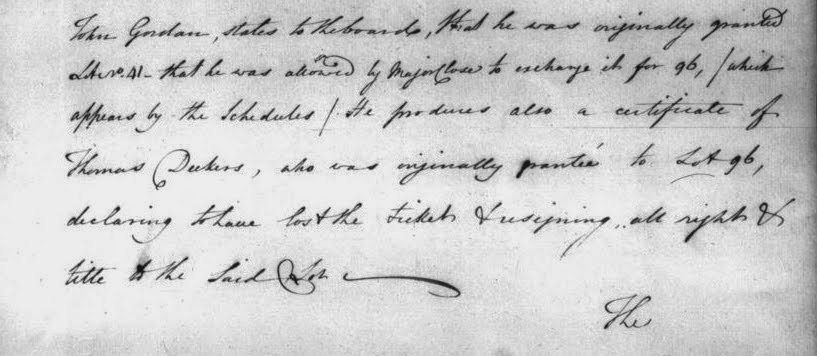
This record reads as follows:
Minutes and Records of the Land Boards Accumulated by the Executive Council Office
John Gordon, states to the boards, that he was originally granted Lot No. 41, that he was allowed by Major Close to exchange it for 96, / which appears by the Schedules / He produces also a certificate Thomas Deckers, who was originally grantee to Lot 96, declaring to have lost the ticket & assigning all right & title to the said Lot —-

Further records from Upper Canada indicate that Thomas Decker received this "ticket", or right to claim land for his service in the British Royal Army during the American Revolutionary War. 
Name: Decker, Thomas
District: Hesse
Year: 1791
Description: List of disbanded Rangers and Loyalists residing at or near Detroit
Volume: 3
Page(s): 374 [Image 582], 378 [Image 589, of Regiment 84], 391 [Image 604]; pgs 314 [Image 516], 319 [image 521] Received Provisions
Reference: RG 1 L4
Microfilm: C-14026
This page begins the list of Butler's Rangers applying for provisions.
This is the rest of the list, Thomas Decker's name appears as sixth on the list.


Thomas Decker (sixth from bottom on the list) is shown here as part of Butler's Rangers. He was employed as a laborer, and was living "In the Settlement" meaning he was living in the town of Detroit.

From all of this we can discern that in the early 1790s Thomas Decker was living in, or very near, the town of Detroit. He had received a certificate for 200 acres of land for his service in the British Royal Army. However, he had traded this land grant, that would have placed him north of Lake Ontario, in favor of a chance to purchase land on the Detroit River as part of a new settlement there. The rest of the images make it clear that he had served as one of Butler’s Rangers. 

Col. John Butler assembled his troops beginning in 1777. They were specifically assigned to coordinate their efforts with local Indian tribes, in efforts to thwart the Rebel Army's incursions into the northern colonies. Their efforts originally were concentrated in upstate New York and northern Pennsylvania, but eventually spread to as far west as Ohio and as far south as Virginia. 


Thomas Decker appears sixth from the bottom on this list.


The Upper Canada historical documents further show that Thomas Decker served in the 84th Regiment during the early stages of the Revolutionary War. The 84th Regiment of Foot came from the area of upstate New York, near Lakes Ontario and Erie. In 1 August 1778, John McDonell, who had been serving in the 84th Foot, was commissioned as a Captain in Butler’s Rangers. It is likely that McDonell managed to transfer men from his former regiment into his new group. Thomas certainly served in both the 84th Foot and Butler's Rangers with John McDonnell. 

A surprising revelation is found in this brief history of the 84th Regiment of Foot in Wikipedia:
"The 84th Regiment of Foot (Royal Highland Emigrants) was a British regiment in the American Revolutionary War that was raised to defend present day Ontario, Quebec and Atlantic Canada from the constant land and sea attacks by American Revolutionaries.[1] The 84th Regiment was also involved in offensive action in the Thirteen Colonies; including North Carolina, South Carolina, Georgia, Virginia and what is now Maine, as well as raids upon Lake Champlain and the Mohawk Valley. The regiment consisted of 2,000 men in twenty companies. The 84th Regiment was raised from Scottish soldiers who had served in the Seven Years' War and stayed in North America. As a result, the 84th Regiment had one of the oldest and most experienced officer corps of any regiment in North America.[2] The Scottish Highland regiments were a key element of the British Army in the American Revolution.[3] The 84th Regiment was clothed, armed and accoutred the same as the Black Watch, with Lieutenant Colonel Allan Maclean commanding the first battalion and Major General John Small of Strathardle commanding the second.[4] The two Battalions operated independently of each other and saw little action together."
Wikipedia Article "84th Regiment of Foot (Royal Highland Emigrants" http://en.wikipedia.org/wiki/84th_Regiment_of_Foot_(Royal_Highland_Emigrants)

That the 84th Regiment "was raised from Scottish soldiers who had served in the Seven Year's War" makes it possible that the Decker name came to America by way of Scotland. Thomas Decker may have come to America in order to serve as a Scottish Royal Highland soldier during the French and Indian War. After his service was complete, he settled along with many of the 84th Regiment in the vicinity of Lake Ontario in the colony of New York. When the Revolutionary War began, he served with the loyal 84th again, against the rebellious colonists. 

The Decker name does not seem to be Scottish in origin. Most of the Deckers in America probably came here from the Netherlands, settling in the northern colonies when they were still part of New Amsterdam. It is possible that the Decker family may have fled to Scotland from the Netherlands, or the Flemish region of Belgium, during the late 1500s, at the time when many Protestants were fleeing religious persecution for their faith. It is known that many of these people emigrated during the late 1500s, some coming to England or Scotland. The Deckers may have been part of that migration. 

Much more research needs to be done to consolidate or refute these findings. I would welcome any comments that might lead to correcting or expanding upon this information.